


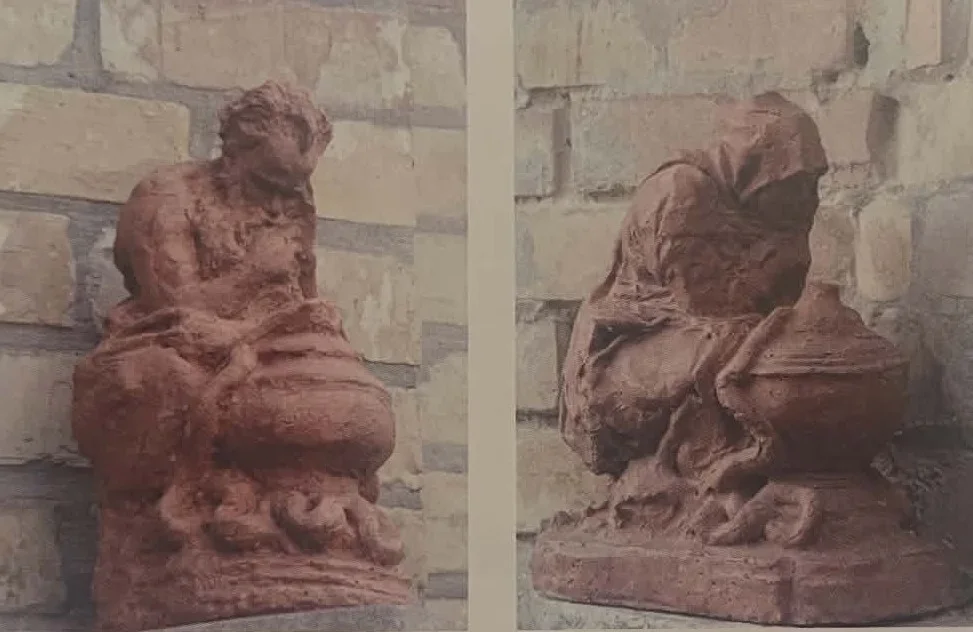
The Theosophical Funerary Monument is one of Bory Jenő’s most individual works: departing from the tradition of Christian funerary monuments, it presents the symbolic system of Theosophy and places at its centre the ideas of the eternal cycle, reincarnation and spiritual development.
Now situated in Plot 77 of the New Public Cemetery in Budapest, the funerary monument was originally erected in Kerepesi Cemetery and was made by Bory Jenő in 1922. The memorial was raised in memory of Berta Schwitzer, a Theosophical writer and the wife of the physician Tivadar Szörényi. The Szörényi family moved to Budapest in 1905. Dr Tivadar Szörényi worked as a neurologist at Liget Sanatorium, while his wife was among the notable figures of the Hungarian Theosophical movement. The monument’s particular distinction lies precisely in its use not of traditional Christian iconography, but of the symbolic language of Theosophy.
The central figure of the memorial is a seated mahatma, or “master”. Before him stands an urn encircled by a serpent biting its own tail, the so-called ouroboros. In Theosophy this symbol expresses eternity, existence without beginning or end, and the eternal cycle of the universe. The urn originally bore the mosaic inscription “Was – Is – Shall Be”, as well as symbols representing circulating cosmic energy. By now, these have largely been destroyed. The inscription on the funerary monument articulates one of the fundamental ideas of Theosophical thought: “Your dust belongs to the earth; your soul has found its way towards another existence.” The work does not emphasise death, but rather the idea of the soul’s continuance and development. In this it differs from most of Bory Jenő’s cemetery works, which generally draw upon Christian or allegorical symbolism.
The funerary monument was later transferred from Kerepesi Cemetery to the New Public Cemetery, presumably after Dr Tivadar Szörényi’s death in 1951. Its condition is now, regrettably, severely deteriorated: much of the mosaic is missing, and the reinforced-concrete structure has been damaged in several places. Nevertheless, it remains one of the most exceptional works of Hungarian funerary art and of Bory Jenő’s oeuvre, significant also from the perspective of the history of religion.
The subject can also be viewed at Bory Castle as a small sculpture in two versions and two materials, ceramic and reinforced concrete, each measuring 31 cm.