


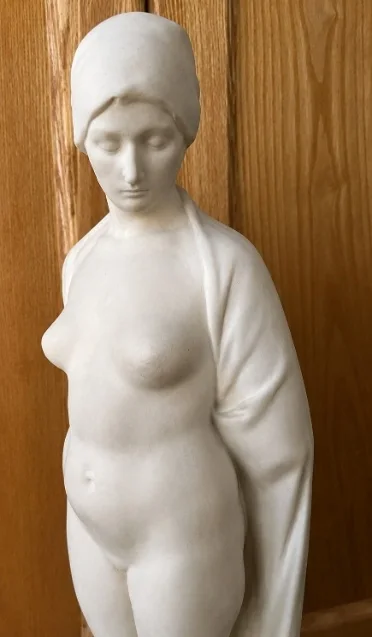
Monna Vanna is one of Bory Jenő’s significant depictions of the female figure, representing a literary-inspired character of strongly symbolic meaning.
The story on which the sculpture is based centres on Giovanna (Monna Vanna), who, to save her husband’s city, accepts the humiliating condition of entering the enemy commander’s tent wearing only a single veil. The turn in the story is that the commander, who is in fact her former lover, does not abuse the situation and sends food to the city. The woman’s decision and moral steadfastness thus become the story’s most important element.
Bory’s sculpture captures this liminal situation: the female figure is at once vulnerable and strong. The motif of the veil has not only a physical but also a symbolic meaning; it is a sign of purity, sacrifice and inner strength.
The work was also made in several versions. According to Bory’s recollections:
- six casts were made in bronze, one of which was purchased by the City of Budapest (now in the collection of the Hungarian National Gallery),
- a single version was made in marble, which is in the dining room of the museum flat at Bory Castle,
- in addition, pyrobasalt, plaster, ceramic and other versions are known, which may be seen in the studio and the museum flat (at approximately 53 cm in height).
Of particular interest is that some versions show a cross around the female figure’s neck, while this motif is absent from others, indicating subtle differences between the various executions.
The sculpture was also shown in contemporary exhibitions. It was exhibited at the Venice International Exhibition and at the 1910 spring exhibition of the Műcsarnok, indicating that the work received considerable attention in its own time.
Monna Vanna is an apt example of the duality of Bory’s female figures: the union of the classical ideal of beauty and Symbolist content. The figure does not portray a particular person, but makes visible a moral situation and a state of mind; here, the female body conveys ideas.