


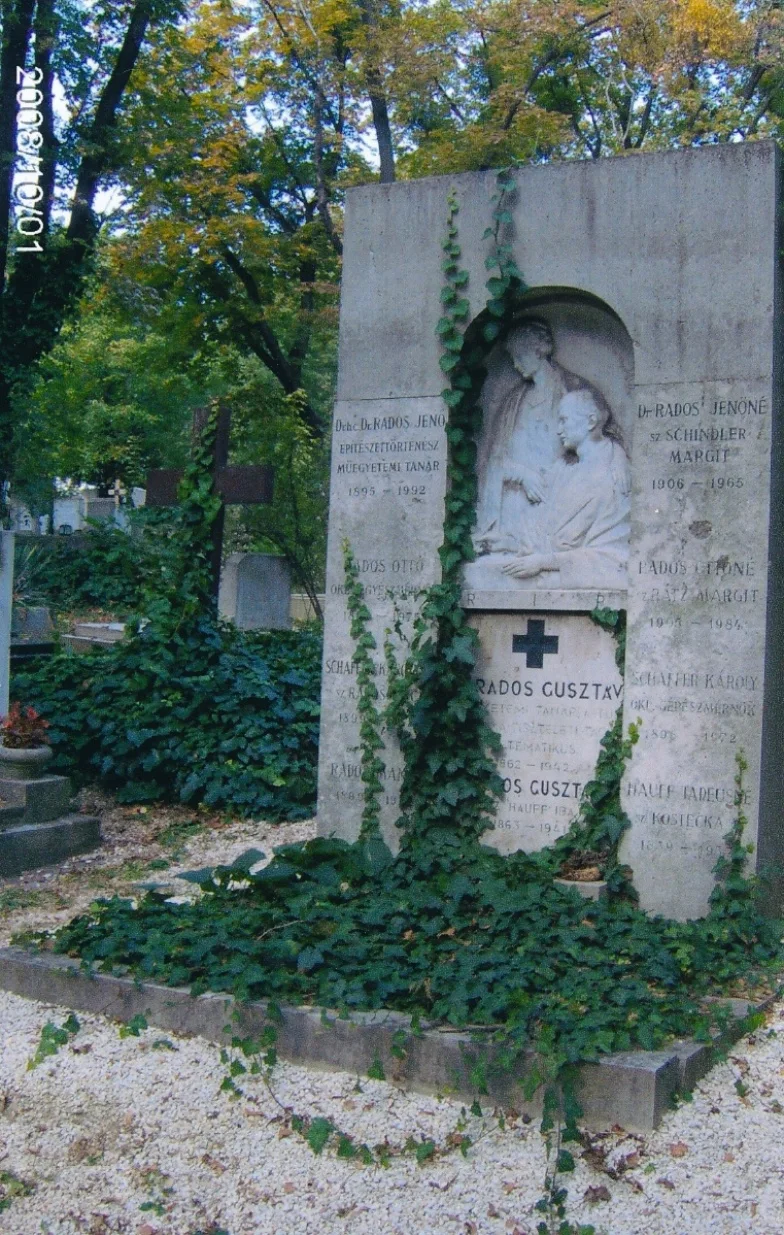
The funerary monument of Rados Gusztáv is among Bory Jenő’s memorials that evoke a scholar’s life’s work not only through a portrait, but through symbols of commitment to science and education.
The funerary monument of Rados Gusztáv in Farkasréti Cemetery in Budapest was made by Bory Jenő in 1942. The memorial stands in Plot 7/7-1-9/10 and is a significant work of the artist’s late funerary sculpture.
Rados Gusztáv (1862–1942) was a mathematician, professor at the Technical University and rector. He studied at the Technical University in Budapest, the University of Budapest and the University of Leipzig. He taught at the Technical University from 1885 and then served as head of the institution’s library from 1897 to 1933. He also held the office of rector on several occasions. The best-known result of his scholarly work is the Kőnig–Rados theorem, still known in mathematics today.
The funerary monument consists of an architectural section 250 centimetres high, at the centre of which is a semicircular statue niche. It contains the marble relief, measuring 65 × 100 centimetres, which commemorates the deceased. The relief is signed in the lower left-hand corner: “Bory J.”. The composition’s particular feature is its two-figure allegorical representation, which seeks not merely to provide a portrait, but also to embody the ideal of scientific and intellectual activity. Here too Bory chose a solution characteristic of his funerary monuments: he evokes the deceased’s life and personality in symbolic form.
The funerary monument has been restored in recent years: the relief has been cleaned, the inscriptions restored and the stone surfaces conserved, so that it can once again be seen in its original beauty. The funerary monument of Rados Gusztáv preserves both the memory of an outstanding mathematician and Technical University leader, and the legacy of a defining figure in the history of Hungarian technical higher education and science.