


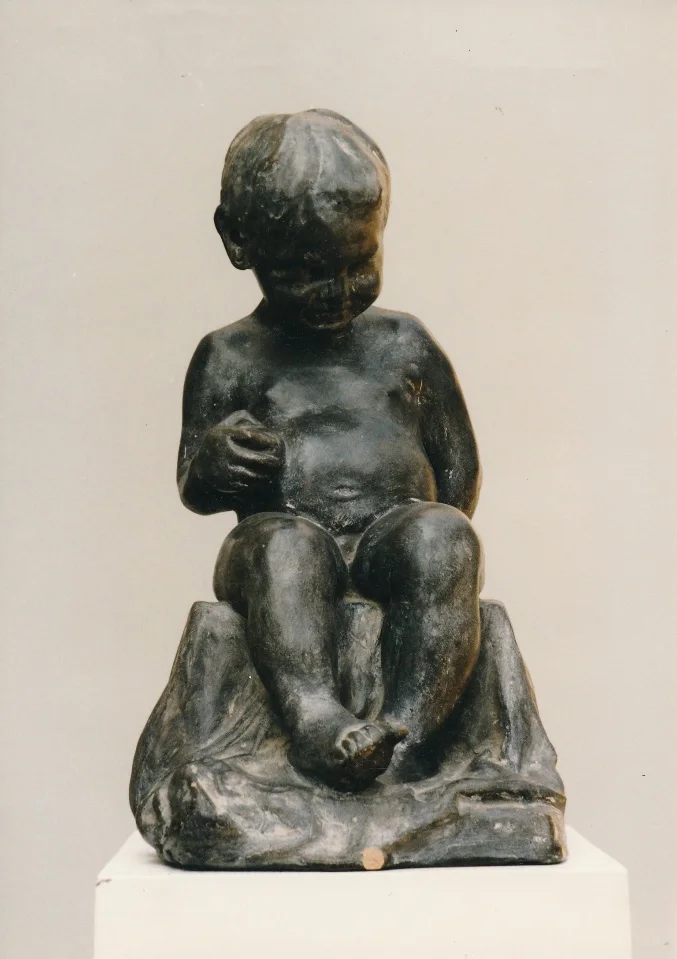
His first work was ‘Bandika’, a small boy clutching an apple, with which he made his debut at the 1906 exhibition of the Fine Arts Society.
Bory Jenő served for a year as a volunteer soldier in Vienna, after which he was offered the headship of the engineering office in Székesfehérvár; instead, he enrolled at the Model Drawing School. At that time there was still no training in sculpture in Hungary, but with Bory there were now two applicants, so the course could begin. Drawing was taught by Antal Lorántffy, but Bory preferred to attend the classes of Bertalan Székely. While the others worked out their tasks in drawing, he resolved them in clay, sculpturally. Some of these small sculptures were later realised on a larger scale.
The elderly master Alajos Stróbl set his pupils the task of modelling an infant as a live model. The child was extremely restless, crying, screaming and kicking, so the task had to be abandoned. Bory asked his elderly master if he might invite the little boy back the following day. And, to everyone’s surprise, the next day, after an apple had been placed in his hand, the child behaved calmly and the statue could thus be completed. We regard this work as Bory Jenő’s first creation.
This work, as well as his other depictions of children, reveals a high degree of psychological sensitivity. Conveying childhood is no easy task; the sculptor can readily fall into the trap of sentimentality. Bory resolved the task with ease, working with compact, broadly treated forms, seeking to omit every unnecessary detail and concentrating on the most characteristic features of the subject.