


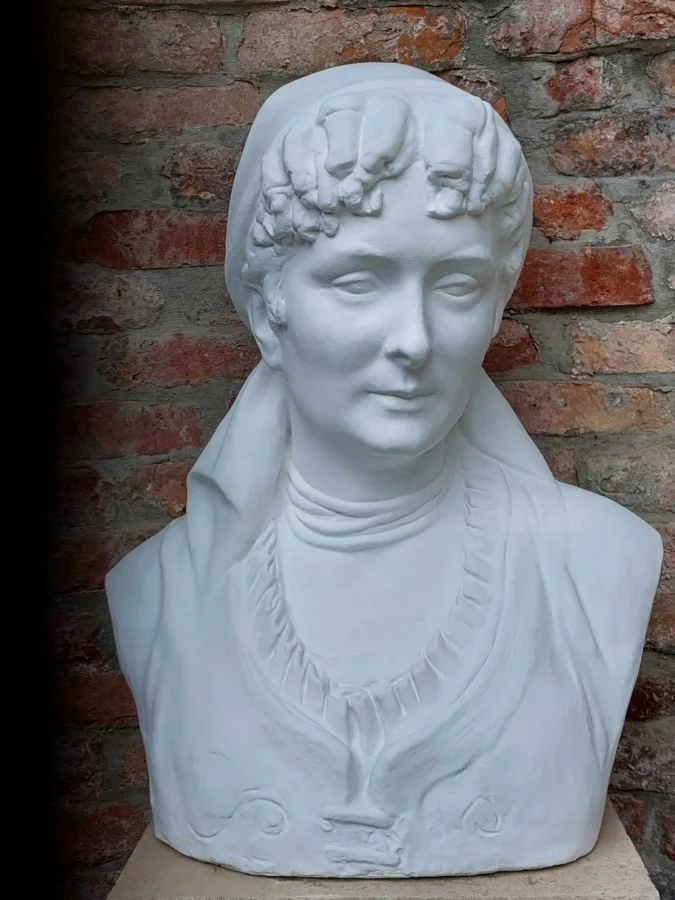
In Bory Jenő’s artists’ gallery, a place is also given to one of the most significant figures of Hungarian theatre, Blaha Lujza, the ‘nightingale of the nation’. Born in Rimaszombat, the actress was one of the most popular stage personalities of the second half of the nineteenth and the early twentieth centuries; her name survives to this day in that of one of Budapest’s best-known public squares, Blaha Lujza tér.
The plaster bust preserved at Bory-vár forms part of the gallery’s series of portraits. Bory Jenő portrays Blaha Lujza in her later years, setting aside the outward trappings of stage roles and theatrical effect. The calm gaze, harmonious proportions and softly modelled features create a portrait that emphasises not primarily the actress’s popularity, but the dignity of her personality and her artistic authority. The portrait accords well with the aim of Bory Jenő’s portrait sculpture to capture the inner character and intellectual significance of the person portrayed. Both a classicising approach to portraiture and the sensitive depiction of the soul characteristic of the turn of the century are present in the statue’s composition. The elaborately formed hairstyle and the shawl falling over the shoulders evoke the characteristic dress of the period, while restrained solemnity characterises the work as a whole. Bory did not seek to immortalise the celebrated prima donna of the stage, but the artist who became one of the defining figures of Hungarian-language theatre.
Several public versions were made from the original plaster model. The best known is the bronze bust erected in 1940 in the main square of Rimaszombat, commemorating Blaha Lujza’s birthplace. An aluminium version installed in Széchenyi Park in Szentes was also made from the same portrait and unveiled in 1943. The statue in Szentes is noteworthy from both art-historical and technical-historical perspectives, as it was the first aluminium casting made by Bory Jenő’s own patented process. The bust was stolen in the 1990s and has not been recovered since, so the plaster version preserved at Bory-vár has remained an especially important bearer of the work’s memory.
The portrait of Blaha Lujza in the artistic pantheon of Bory-vár preserves not merely the memory of an outstanding actress, but also commemorates the age when Hungarian theatre became one of the most important formative forces of national culture. The statue is both a tribute to the artist and an example of the way Bory Jenő united individual character with the ideal of cultural memory in his portrait sculpture.