


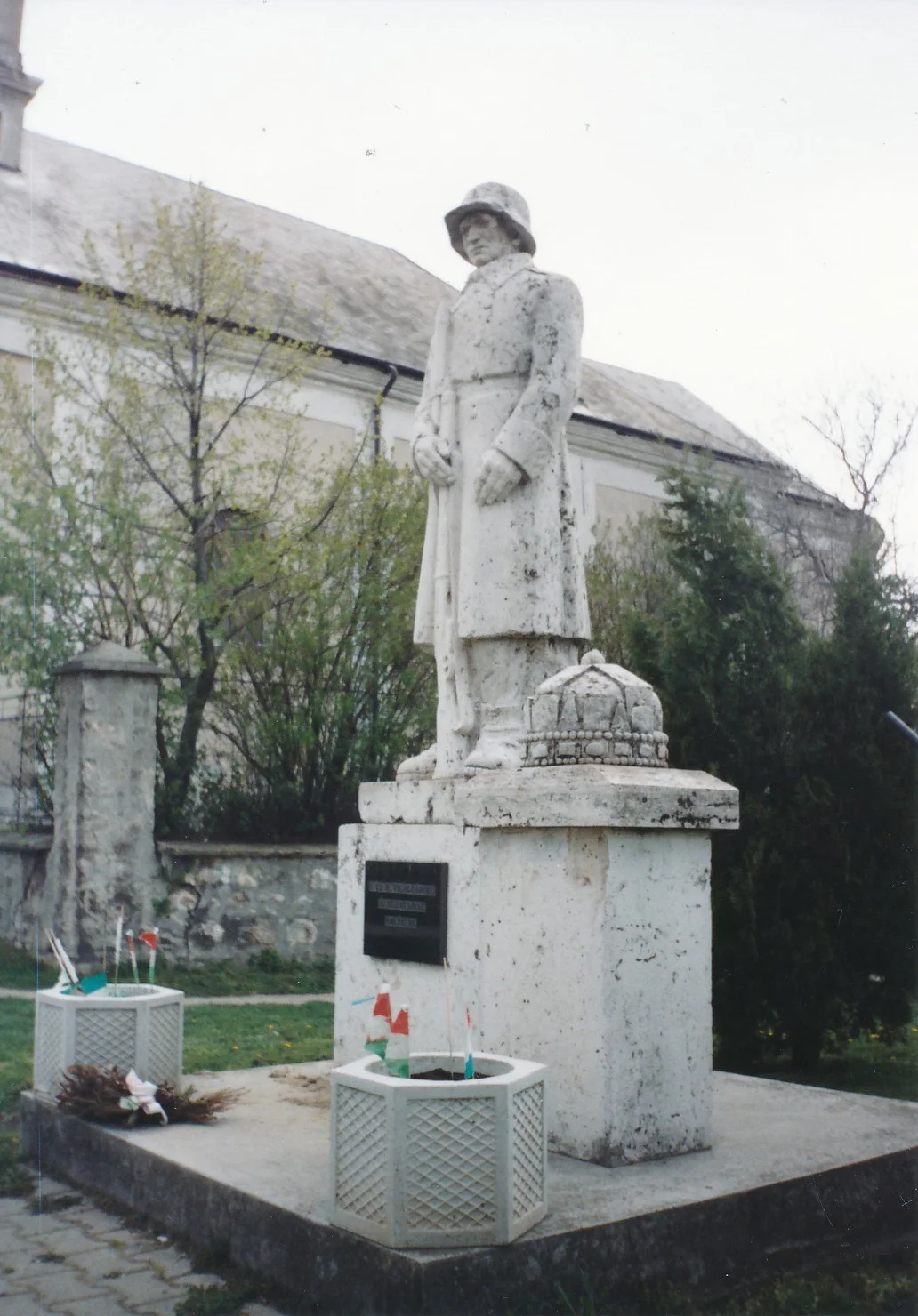
The Isztimér War Memorial occupies a distinctive place among Bory Jenő’s war memorials. Its history shows how an earlier work may acquire a new meaning and community role decades after its creation. It now stands in public space beside the Catholic church and commemorates the victims of the First and Second World Wars.
The central element is a statue of a soldier made by Bory Jenő. It originally stood not as part of the present memorial but in the garden of the Catholic church. A surviving inscription records that in 1944 it was erected by four siblings in memory of family members killed in the war: ‘The statue was commissioned by the four siblings in 1944 in memory of their father and son, fallen heroes.’
Following the change of regime, a wish arose in Isztimér for a Second World War memorial. In November 1992 Miklós Szabó, district notary, proposed to the representative body that the Bory statue in the church garden be adapted as the village memorial. Under his proposal, plaques would be placed on the base, allowing the existing work to become a site of remembrance for the whole settlement. The final decision moved the memorial to public space beside the Catholic church. Contrary to earlier plans, the names of the dead were not carved on the base; general commemorative inscriptions were used instead. The principal one reads: ‘In memory of the victims of the First and Second World Wars’. The memorial therefore preserves not the memory of one family or person, but commemorates the war losses of the entire community. It was ceremonially unveiled on 31 July 1993, when Isztimér celebrated the 800th anniversary of its foundation, making the unveiling a principal jubilee event. Through this gesture the settlement connected its historical past with tribute to the victims of war.
Artistically, the Isztimér work differs from Bory Jenő’s large-scale monumental war memorials. It is not a major urban site of remembrance, but an intimate soldier statue made for a village community. The figure nevertheless carries the same ideals found in Bory’s First World War memorials: duty, steadfastness, sacrifice and reverence for heroic memory.
Today the memorial preserves both the memory of a Bory work born of a family initiative and the community’s respect for its First and Second World War victims. This double function makes it especially valuable in Bory Jenő’s memorial-sculptural oeuvre and in the local history of Isztimér.