


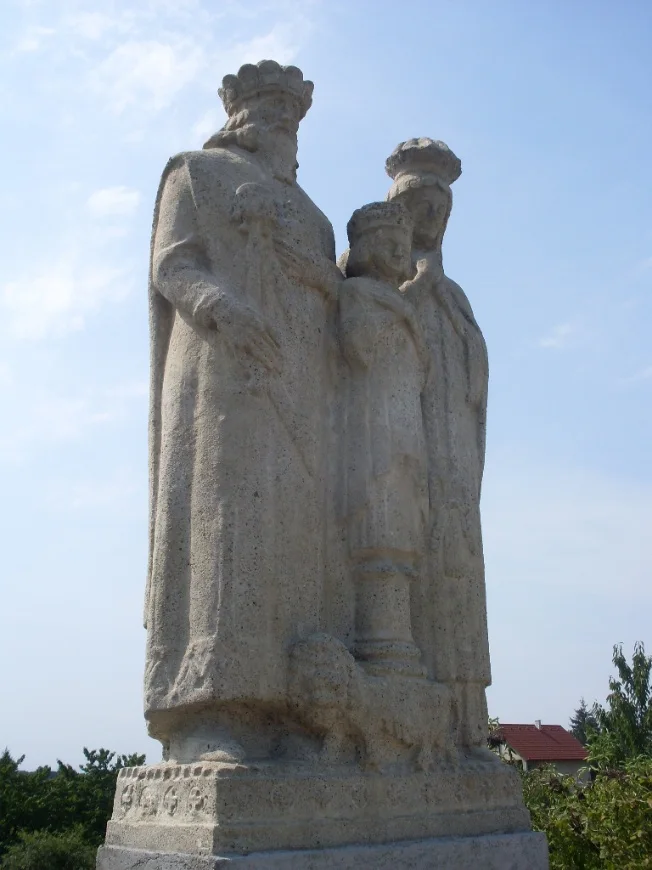
One of the sculptural groups in the historical arcade depicts Saint Stephen, Queen Gizella and Saint Prince Imre. Together, the three figures represent the birth of the Christian Hungarian state, as well as the dynasty whose members remained exemplars of Hungarian Christianity for centuries.
At the centre of the composition stands King Saint Stephen, who organised the alliance of Hungarian tribes into a unified Christian kingdom. During his reign, the system of bishoprics and counties took shape, determining the country’s administration for a long time. His figure symbolises the union of Hungarian statehood and the Christian faith.
Beside him is his wife, Queen Gizella, a member of the Bavarian ducal family. Their marriage not only created a dynastic link between Hungary and the Holy Roman Empire, but also contributed to the strengthening of Christian ecclesiastical and cultural connections. According to tradition, Gizella played an important part in supporting churches, monasteries and ecclesiastical institutions.
Between the two rulers stands Prince Imre, heir presumptive to the throne. Particular care was devoted to his education: Bishop Saint Gellért also took part in it, and Stephen wrote for him the work entitled Admonitions, one of the important sources for medieval Hungarian political thought. It was hoped that the prince would continue his father’s work, but he died in a hunting accident in 1031 and was thus unable to ascend the throne.
Bory Jenő formed the three figures as a close unity. The sculptural group does not depict a historical event, but an ideal: the image of a Christian ruling family. This emphasis is reinforced by the fact that the Church venerates all three persons as saints. The composition evokes at once the age of the foundation of the Hungarian state and the spiritual legacy that the figures of Stephen, Gizella and Imre represent in Hungarian historical memory.
Alongside the quartz-concrete sculptural group visible at Bory-vár, a porcelain version of the work is also known. This offers a fine example of Bory Jenő’s creative method, through which he shaped some of his compositions in different materials and sizes. The Holy Royal Family in Herend porcelain depicts the king who founded the Hungarian state, Blessed Gizella and Saint Prince Imre in a finely worked, small-scale sculptural form. The porcelain statue has particular significance because Bory Jenő’s descendants presented it to Pope John Paul II in 1996, on the occasion of his visit to Hungary. A papal letter of thanks in Hungarian associated with the statue has also survived. In 2026, the work was also shown at the exhibition entitled Totus Tuus – Wholly Yours at the King Saint Stephen Museum in Székesfehérvár, where the porcelain work presented to the pope and its accompanying letter of thanks were displayed together.