


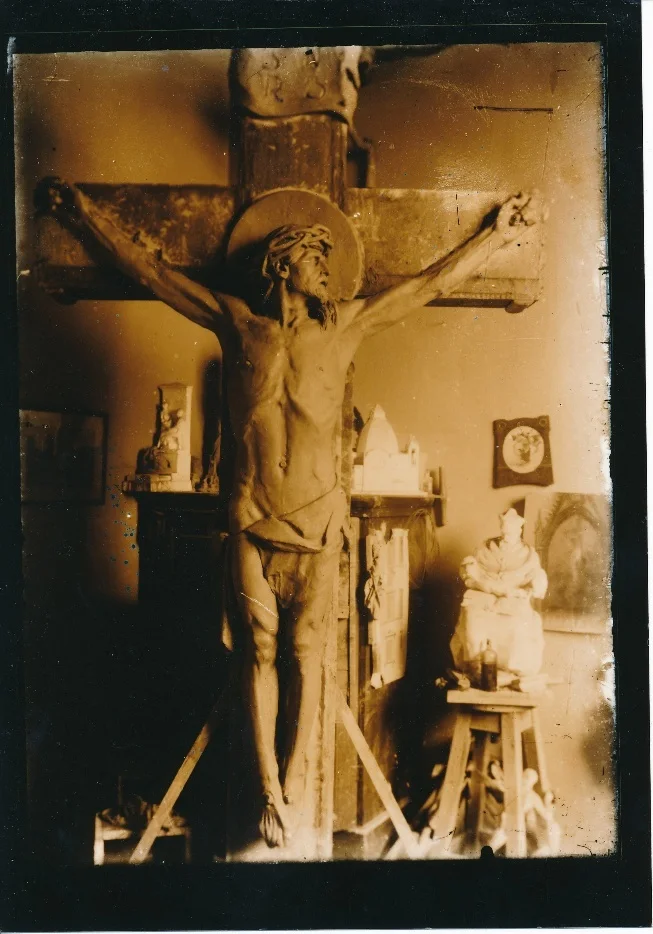
The Paizs family funerary monument at Rácalmás is among Bory Jenő’s earliest known cemetery works, and it clearly demonstrates that, from the outset of his career, the artist sought to unite architectural and sculptural elements.
The Pajzs family funerary monument in the Catholic cemetery at Rácalmás was made by Bory Jenő in 1911. The monumental memorial was commissioned by Dr Gyula Pajzs of Rácalmás for his family. Its central feature is a crucifix 570 centimetres high, bearing a large-scale corpus of Christ, while the architectural section reaches an overall height of 850 centimetres.
The commissioner, Dr Gyula Pajzs of Rácalmás (born Gyula Pick), read law in Paris and, alongside his work as a solicitor, also obtained a qualification in agriculture. By purchasing indebted estates he became a substantial landowner and established a model farm at Rácalmás. He ran a model dairy and a pig-fattening enterprise, and also played a part in developing hemp cultivation and processing. In recognition of his work in the administration of Fejér County, Franz Joseph I granted him a noble title with the territorial designation of Rácalmás in 1898. He was also known as a Member of Parliament and an important philanthropist. Gyula Pajzs and his wife, Anna Bischitz, converted to the Catholic faith in 1906. The religious character of the funerary monument and its rich body of quotations also commemorate this change of faith. On either side of the cross are Biblical quotations and thoughts by Bishop Ottokár Prohászka, which emphasise faith in the Resurrection, the hope of eternal life and consolation in mourning.
The inscriptions on the funerary monument:
“The grave is open earth, faith is open heaven, and the believer, even from amongst graves, looks through open heaven into eternal life.” (Ottokár Prohászka)
“The human soul is overcome by sorrow, and all life and existence are shrouded in darkness when we bury, yet amongst our graves another light accompanies and surrounds us, kindled among us by Christ when he said: He who believes in me shall, even though he dies, live for ever.” (John 11:25)
“If you grieve, pray; and if you weep, weep in such a way that eternal hope may ease your sorrow.” (Ottokár Prohászka)
“Do not remember our former iniquities; let your compassion swiftly come before us.” (Psalm 78:8)
“Those whom we have lost and buried here we shall find in God; and those with whom we journeyed together upon the earth for a while, we shall meet upon the paths of eternal love, and there we shall never again be parted.” (Ottokár Prohászka)
“It is a holy and wholesome thought to pray for the dead, that they may be absolved from their sins.” (2 Maccabees 12:46)
By the 1920s the Pajzs family had fallen into poverty and moved to Budapest. Gyula Pajzs died in 1937. His son, Gyula Pajzs the younger, worked as an agricultural entrepreneur and in 1935 founded the Újgalambos Hemp-Dressing and Rope-Making Factory.
The funerary monument at Rácalmás is one of the most imposing works of Bory’s early oeuvre, closely uniting monumental form, religious profession of faith and the history of an important Transdanubian family.