


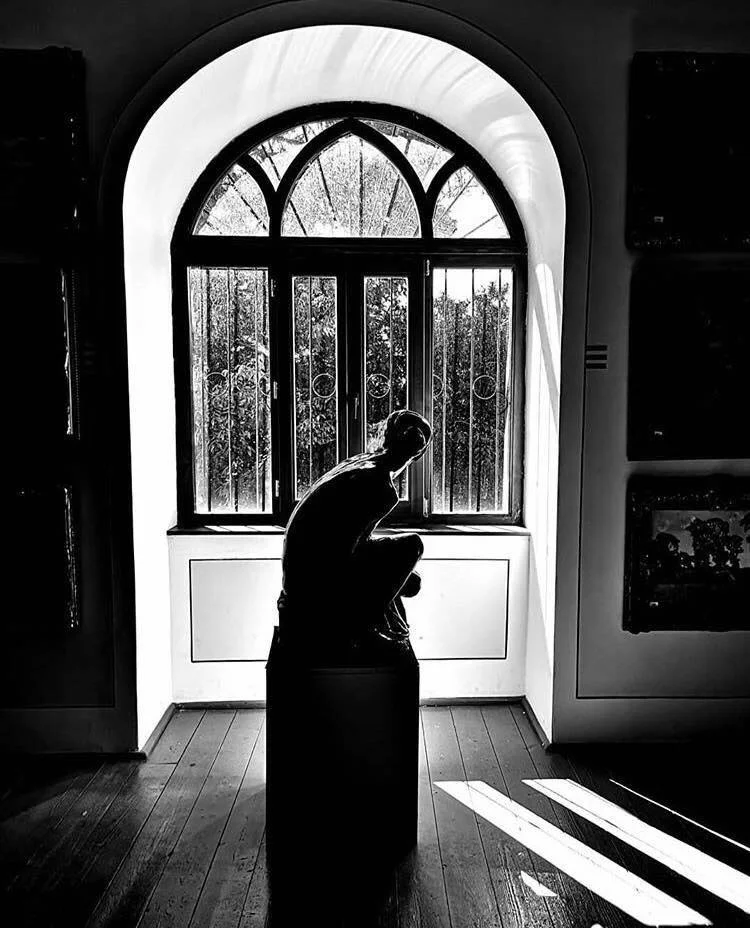
Passing back from the large studio, one reaches the so-called “yellow room”, where the sculpture entitled Susanna at the Bath stands before the window on a low pedestal. The work recalls the biblical story of Susanna: the figure of the bathing woman, observed by the lecherous elders according to the narrative.
Bory Jenő shaped the dramatic moment of the scene with delicate elegance and restrained sensitivity. Crouching on the ground, the female figure draws her richly folded veil around herself in a protective gesture; it serves both as a covering and as one of the composition’s most important formal elements. The naturalness of the pose, the gentle rhythm of the folds and the intimate rendering of the figure give the work its exceptional expressive power. Standing 85 cm high and made of black-fired pyrobasalt, the sculpture is an important work in Bory’s ceramic sculpture. The material’s dark, velvety surface is particularly effective in bringing out the play of light and shade, emphasising the veil’s rich folds and the figure’s delicately modelled forms. The work was greatly acclaimed at an exhibition at the Műcsarnok, to such an extent that the Hungarian state purchased it for the Hungarian Embassy in Berlin, a significant professional and official recognition at the time.
The composition’s popularity is indicated by the fact that Bory also made it in several versions. Alongside the full-length sculpture, a smaller bust version is known, made in marble (48 cm), porcelain (34 cm), ceramic (25 cm) and pyrobasalt (23 cm). The versions in different materials and sizes show that, for the artist, the theme of Susanna was not merely a single creative task, but one of his most cherished expressions of the timeless ideals of human beauty, modesty and feminine dignity.
The story of Susanna (Bible, Old Testament, Book of Daniel 13:1–64):
“Susanna and the Elders is a story in the Old Testament, in the Book of Daniel. Susanna, the wife of Joakim, was a virtuous and God-fearing woman in Babylon. Two corrupt judges secretly desired her and, on one occasion, attempted to force her to yield to them. When Susanna resisted, they falsely accused her of adultery.
Under Jewish law, the testimony of two witnesses was sufficient for judgment, and Susanna was therefore condemned to death. She prayed to God, who sent Daniel to administer justice. Daniel questioned the judges separately; they named contradictory places, thereby revealing their lie. Susanna’s innocence was proven, and the two elders were condemned to death for bearing false witness and intending adultery.”