


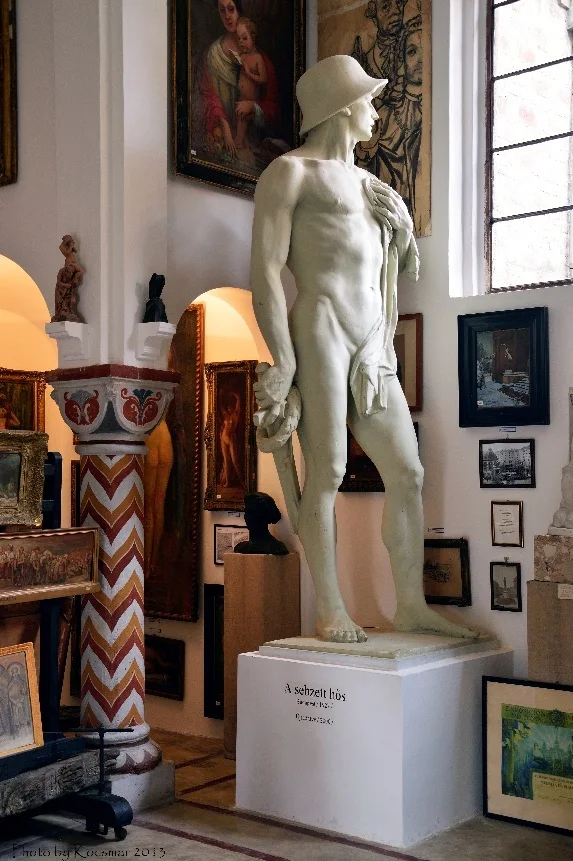
Bory Jenő’s Wounded Hero is not only one of the artist’s most important memorials but also one of the most distinctive war monuments in Hungarian sculpture between the two world wars. The statue in the garden of the Budapest Technical University was made in 1927 in memory of the university students who fell in the First World War and, following its disappearance, was restored to its original site in 2000, almost half a century later.
The idea of erecting the Technical University heroes’ memorial arose directly after the First World War. Many of the institution’s students and teachers had fallen at the fronts, and the university wished to commemorate them fittingly. The foundation stone was laid as early as 1922, during the university’s jubilee, but the memorial could only be realised years later. The necessary funds were raised by public subscription, to which, alongside the students, the National Theatre contributed through a charitable gala performance. Bory Jenő, then already a respected professor at the College of Fine Arts and author of many significant public works, was eventually asked to make the memorial. It was unveiled in the Technical University garden on 20 October 1927. Archduke József gave an address at the ceremony, and the statue soon became one of the university community’s most important sites of remembrance.
Wounded Hero is distinctive above all for its iconography. The three-metre bronze figure depicts a young man whose physique, proportions and pose strongly recall Michelangelo’s celebrated David. Bory did not simply copy the Renaissance master; he transposed his ideal representation of humanity into the world of the twentieth century. The muscular, harmonious male body, the bearing of the head and the classical contrapposto all evoke Renaissance sculptural tradition. Bory nevertheless deliberately disrupts this idealised classical image. The hero wears a modern military helmet, holds a lowered sword in his right hand and presses his left hand to his chest, as though trying to staunch a fresh wound. The classical ideal of beauty and the tragic reality of modern war thus appear simultaneously in the statue.
Wounded Hero is also exceptional because war memorials of the period generally depicted uniformed soldiers, scenes of attack or allegorical figures. By contrast, Bory chose a nude figure. The naked human body does not represent a particular soldier, but symbolises universal human endurance and sacrifice. The work therefore focuses not on military action but on the moral dimension of heroic self-sacrifice. The injury too is portrayed with restraint and symbolic force. There is no blood or dramatic death struggle; only the hand pressed to the chest indicates the wound. For this reason the statue conveys strength, dignity and tragedy at once.
After the Second World War, the statue’s fate took a tragic turn. It was long believed to have been destroyed during the siege of Budapest, but it later emerged that it had survived the fighting. In the political changes after 1948 it was removed from its site, and its bronze, together with that of other Budapest memorials, was used to cast the Stalin statue. Wounded Hero was thereby physically destroyed.
The story did not end there. The statue’s original, full-size plaster model survived in Bory Jenő’s studio in Székesfehérvár, now in the collection of Bory-vár. This rare good fortune made reconstruction possible. In 1993 the Budapest Technical University resolved to restore the memorial; after long preparatory work, a new bronze casting was completed in 1999. The recast statue was unveiled at its original site on 26 May 2000. The memorial’s meaning was then expanded: it commemorates not only Technical University students who fell in the First World War, but also the university victims of the Second World War, the events of 1944–45 and the Revolution of 1956.
Wounded Hero is one of Bory Jenő’s most modern and artistically complex memorials. While many of his war works foreground the attacking soldier or a specific historical event, here the artist confronts the classical ideal of humanity with the destruction of modern war. The Michelangelo influence, the boldness of the nude representation and the statue’s extraordinary afterlife together make Wounded Hero one of the most significant works of twentieth-century Hungarian memorial sculpture.