


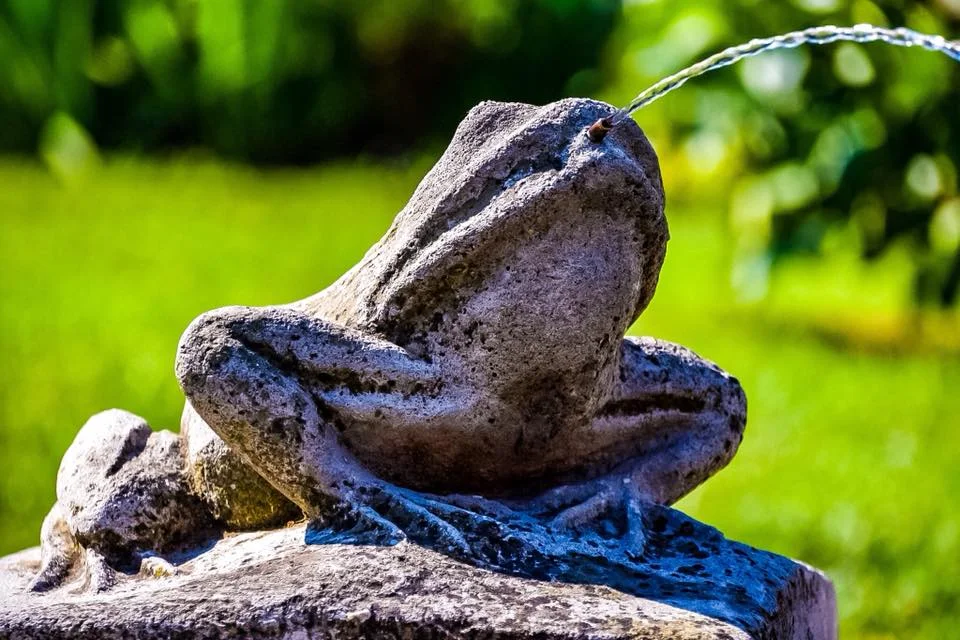
Among Bory Jenő’s animal depictions, the frog occupies a special place, forming an integral part of the pool standing at the centre of the Hundred-Column Courtyard at Bory-vár.
The concrete statue is not merely a decorative element, but also a waterspout: the jet of water emerging from the frog’s mouth falls into the pool, lending life and movement to the composition.
The work offers a good example of Bory Jenő’s endeavour to treat sculpture and the architectural environment as a unity. The frog does not appear as an independent exhibit, but as part of the garden and water architecture. It is connected with water in a way that refers to its natural habitat, so that its function and meaning are closely interwoven. The sculpture is simply and compactly modelled. Bory did not place emphasis on detailed anatomical representation, but captured the animal’s characteristic pose and character. The widely splayed legs, raised head and compact mass make the figure recognisable at a single glance. The slightly stylised treatment is well suited to the architectural world of the castle, where decorative elements and sculptural works form a unified composition.
The pool placed at the centre of the Hundred-Column Courtyard, and the frog sitting upon it, remain one of the endearing details of Bory-vár, offering a fine example of the creator’s playful imagination and of an outlook in which architecture, garden art and sculpture form an inseparable unity.
c