


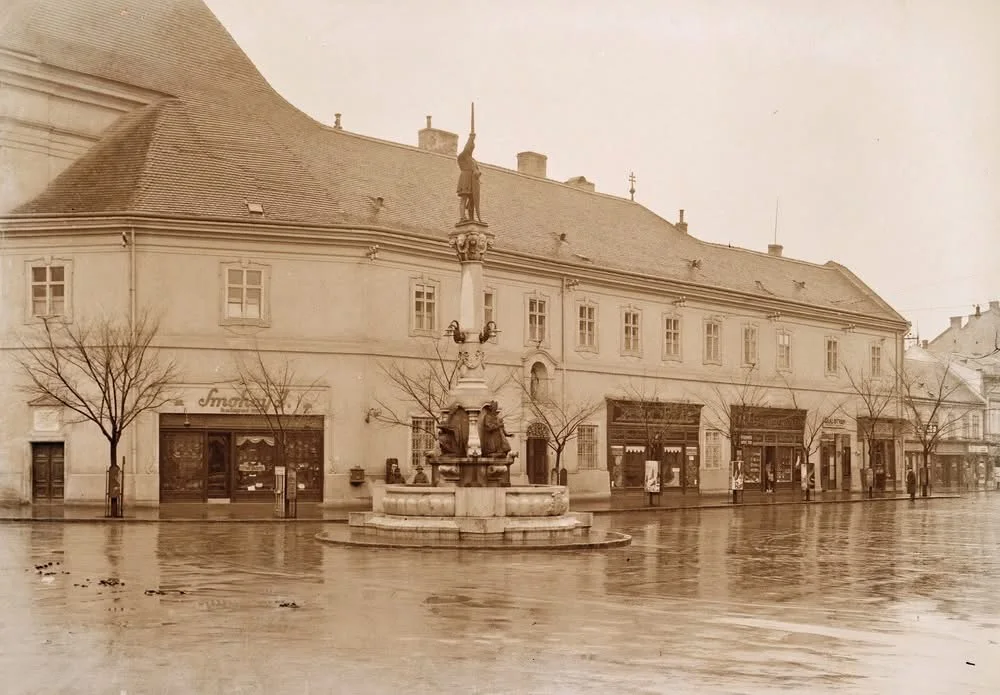
The Bishops’ Fountain in Székesfehérvár is one of Bory Jenő’s most significant public works, revealing him as both sculptor and architect. Made in 1928, the monumental ornamental fountain evokes the foundation of the Hungarian state and the establishment of the Christian Church organisation.
The work originally stood on the site now occupied by the Országalma, and was moved in 1937 to the square in front of the railway station. After the Second World War the bishop statues were removed, but fortunately survived; in 1972 the memorial could therefore be returned to its present site in its original form.
The central figure is a warrior of the Árpád period, embodying the defender of the Christian Hungarian state. Around the column stand four ecclesiastical figures who played defining roles in King Saint Stephen’s work of organising the state and founding the Church. Bory Jenő himself articulated the statues’ symbolic meaning: Asztrik represents the Church supporting the kingdom, Gellért the martyr Church, Mór the teaching Church, and Adalbert the missionary Church.
On the south side stands Saint Adalbert (Vojtěch), Bishop of Prague, one of the most important figures in the early history of Hungarian Christianity. Tradition holds that he baptised Grand Prince Géza and his son Vajk, the future Saint Stephen. Through his missionary work, he became one of the founders of the western Christian network of relations of the Hungarian state. Bory portrayed the saint as a dignified bishop, stressing his missionary role. In the artist’s interpretation, Adalbert symbolises the missionary Church.
On the north side is the statue of Blessed Asztrik, Abbot of Pécsvárad and Archbishop of Kalocsa. Historical tradition holds that he brought from Rome Pope Sylvester II’s blessing and the royal crown for Saint Stephen. Bory therefore depicted him holding the Holy Crown. Asztrik represents the alliance of state and Church, as a key figure in the birth of the Christian kingdom. For the artist, he embodies the Church that supports the kingdom.
On the east side stands Saint Gellért, Bishop of Csanád, one of the best-known martyrs of the Hungarian Church. A Benedictine monk of Venetian origin, he came to Hungary and, at Saint Stephen’s behest, participated in the country’s Christian education. He is traditionally revered as tutor to Prince Saint Imre. He suffered martyrdom during the pagan uprising of 1046. Bory Jenő’s statue stresses sacrifice for faith, and Gellért therefore symbolises the martyr Church in the work’s iconographic programme.
On the west side is Blessed Mór, Bishop of Pécs. Mór was among the first known Hungarian writers and composed the legend of Saints Zoerárd and Benedict. His work in Church organisation, teaching and cultural organisation gave him particular importance in the Árpád period. In Bory Jenő’s interpretation, he embodies the teaching and cultivated Church. His calm, contemplative figure is well suited to this role.
The Bishops’ Fountain is not simply an ornamental fountain, but a complex historical memorial. Together the four bishops symbolise the foundations of the Christian Hungarian state, while the central warrior embodies the secular strength of the young Hungarian kingdom. In this composition Bory Jenő successfully combined historical memory, ecclesiastical-historical content and the means of monumental public sculpture. It is no coincidence that he received the Ipolyi Arnold Prize in 1929 for modelling the bishop figures.
The plaster models of the bishops can be seen beneath the arcades of the Hundred-Column Courtyard at Bory-vár.