


One of Bory Jenő’s earliest public works in Székesfehérvár is the Turul Memorial in Halesz Park, commemorating the martyrs from the city who fell in the War of Independence of 1848–49. The statue is not merely a work of art but also an outstanding symbol of the city’s historical memory.
The history of the memorial reaches back to 1888, when the city of Székesfehérvár erected a simple commemorative column in what was then Erzsébet-liget, in memory of the six victims of the Halesz uprising. The names of the executed honvéd soldiers and the words of remembrance were inscribed on the column: ‘In remembrance, by patriotic piety, of the thousand victims of the defensive struggles of 1848–49.’ The city’s inhabitants, however, did not consider the plain, unornamented column worthy of the martyrs’ memory. Because of its form it was commonly called merely a ‘candlestick’, and many felt the memorial unfinished. Public subscription was therefore launched at the beginning of the twentieth century for a more artistically rich and representative design.
The Halesz memorial commemorates the tragic chain of events that unfolded in Székesfehérvár in August 1849. In the final weeks of the War of Independence, the town’s citizens and National Guards, led by Imre Hamvassy, organised a popular uprising against the approaching imperial troops. The clash fought near Halesz ended in defeat, and Austrian troops captured several participants, including National Guard captain Ferenc Havelka, lieutenant András Hübner, Mihály Varga, Ignác Uitz, Mihály Kuczka and Pál Gáncs. The prisoners were taken to Pest, tried by court martial and executed on 14 August 1849. They became the first martyrs of Székesfehérvár in the reprisals following the War of Independence.
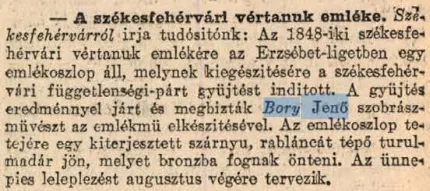
The city authorities eventually commissioned Bory Jenő to provide the memorial’s artistic completion. The sculptor designed for the top of the column a huge Turul bird with outspread wings, breaking its chains. The motif symbolises national freedom, independence and rebirth, while the broken chains express liberation from foreign oppression.
The base itself is another distinctive feature of the memorial. The granite column was made from a pillar stone of the medieval coronation basilica of Székesfehérvár, recovered from the ruins. The work thus links the memory of Hungarian statehood with the heroes of the War of Independence of 1848–49. Ferenc Havelka and his son worked the column, while the bronze Turul is the work of Bory Jenő.
The memorial was unveiled on 6 October 1909, the day of remembrance for the Martyrs of Arad. The chosen date symbolically connected the memory of the Halesz martyrs with the national day of commemoration of the War of Independence.
For more than a century the Turul, standing as the central memorial site of Halesz Park, has preserved the memory of the martyrs of Székesfehérvár. The bronze bird breaking its chains has become one of the city’s best-known historical symbols, expressing both the sacrifice made for freedom and the ideal of national solidarity.
Budapesti Hírlap, 1909-07-25 / issue 175
Budapesti Hírlap, 1909-10-05 / issue 235
Pesti Hírlap, 1909-10-05 / issue 235