


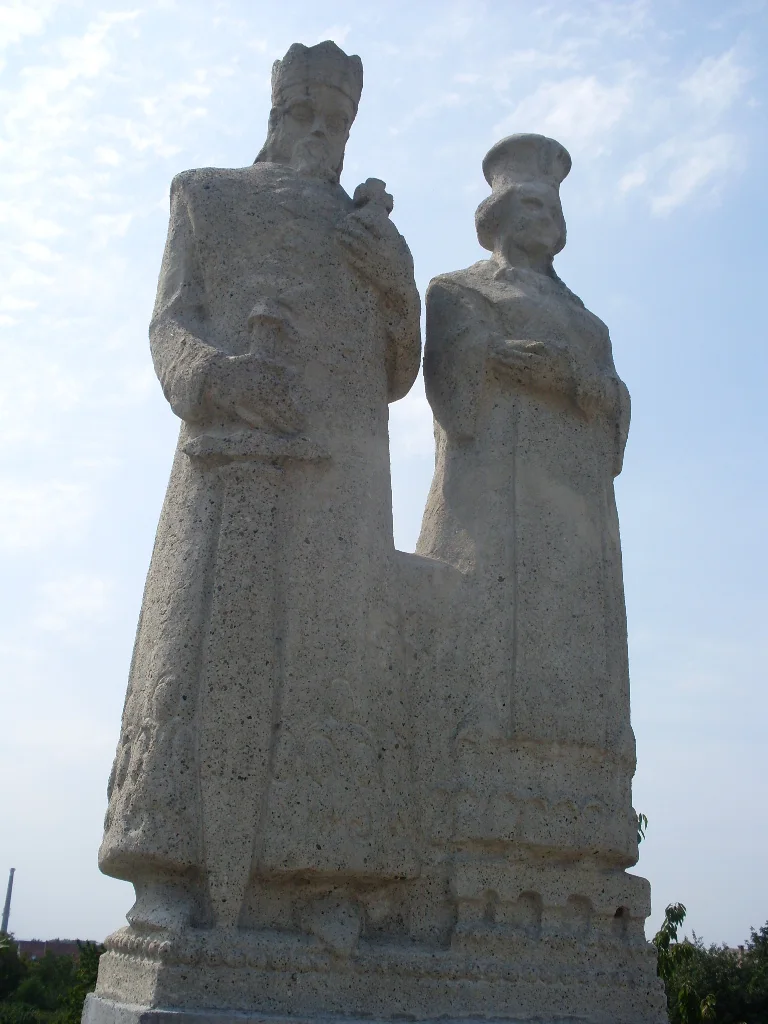
One particularly interesting pair of figures in the historical arcade is King Béla III and his wife, Queen Anna of Antioch. Bory Jenő portrayed the royal couple together, and the most striking element of the composition is the difference in the figures’ stature: beside the tall king stands the considerably shorter queen. This difference is not merely an artistic device, but refers to a historical fact.
The tomb of Béla III (who ruled between 1172 and 1196) and Anna was excavated in December 1848 in Székesfehérvár, among the ruins of the medieval coronation basilica. Among the rulers of the House of Árpád, theirs is the only burial place that archaeology has been able to identify beyond doubt. The skeletons, jewellery and royal insignia discovered in the excavation all confirmed the identity of the royal couple. Researchers were particularly struck by the considerable difference in height between the skeletons, which Bory also represented in his statue.
The royal couple’s original sarcophagi, carved from red limestone, may still be seen in Székesfehérvár. Their distinctive feature is that the stone has discoloured where the king’s and queen’s bodies lay, so that even centuries later the imprint of their former resting place can be discerned. The royal remains were later placed in Matthias Church in Buda, while the objects found in the grave entered the collection of the Hungarian National Museum.
Bory Jenő’s statue therefore evokes not only a significant royal couple, but also commemorates one of Székesfehérvár’s most important archaeological discoveries. The figures of the king and queen connect at once the history of the Árpád period with the past of the coronation city.