


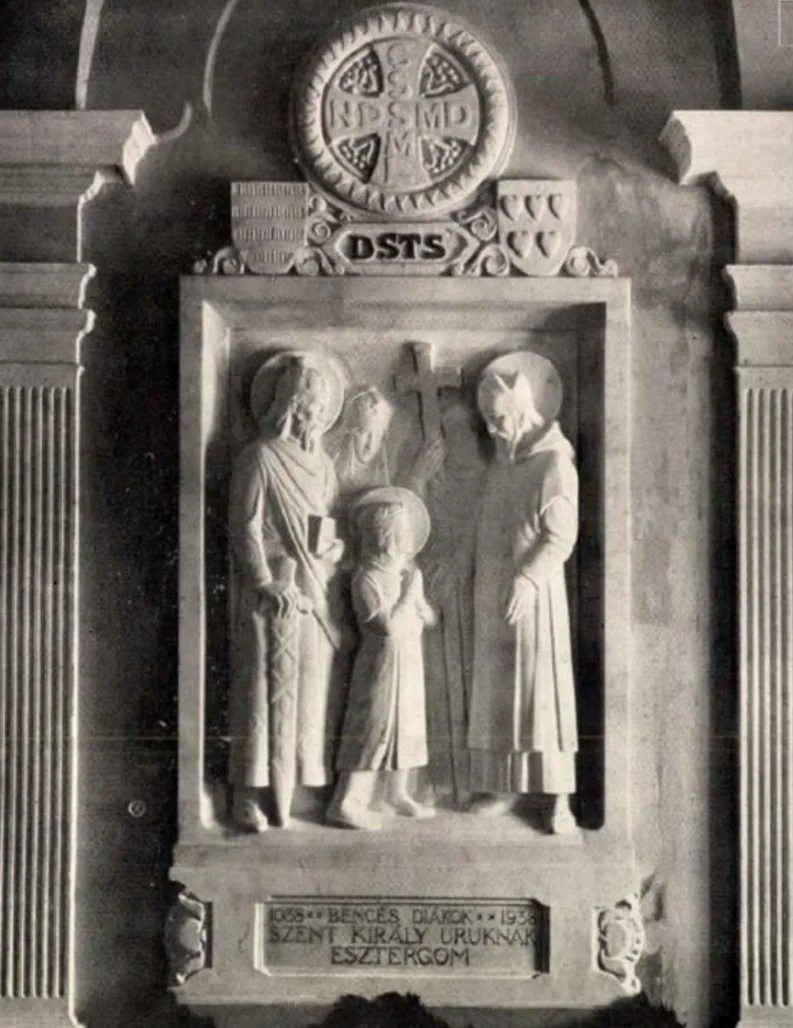
Beneath the arcades of the Hundred-Column Courtyard at Bory-vár stands the plaster model that served as the original model for Bory Jenő’s relief of Saint Stephen, made in 1938. The work was commissioned by the Benedictine Saint Stephen Grammar School in Esztergom for the Saint Stephen commemorative year, held on the 900th anniversary of the death of the king who founded the Hungarian state.
The original work was made of white Carrara marble and measured 165 × 200 centimetres. In a composition of five figures, the artist represented the symbolic moment when King Saint Stephen entrusts his son, Prince Imre, to his tutor, Bishop Saint Gellért. In the background of the scene are the figures of Queen Blessed Gizella and Saint Adalbert. The relief thus expresses at once the idea of the foundation of the Christian state, the importance of education in the faith and the spiritual legacy of the holy royal family.
The relief was unveiled in 1938 in the ceremonial hall of the grammar school in Esztergom, as part of a grand celebration. Beneath the work stood the following inscription: ‘1038 – Benedictine pupils – 1938, to their Holy Royal Lord, Esztergom’
The work was surrounded by a rich marble frame. In its upper part were placed the symbols of the Benedictine order. The Latin abbreviations on the cross-shaped medallion refer to the well-known motto of the Benedictine tradition: Crux Sacra Sit Mihi Lux (‘May the Holy Cross be my light’) and Non Draco Sit Mihi Dux (‘May the dragon not be my guide’). The frame also bore the Benedictines’ coat of arms and a motif depicting five hearts.
The relief’s fate changed after nationalisation. In 1953 it was removed from the grammar-school building, but through local initiative it was saved. With the assistance of master mason Gyula Köves and Demeter Nádai, it was moved to the parish church of Saint Stephen King in Esztergom-Kertváros. The work was set into the apse wall, where it remains visible today.
A further point of particular interest in the history of the work is that the original plaster model has survived. This model is now part of the historical collection of Bory-vár and may be seen beneath the arcades of the Hundred-Column Courtyard. Thus, the marble work in Esztergom and the plaster model in Székesfehérvár together preserve one of Bory Jenő’s important works connected with the Saint Stephen commemorative year.