


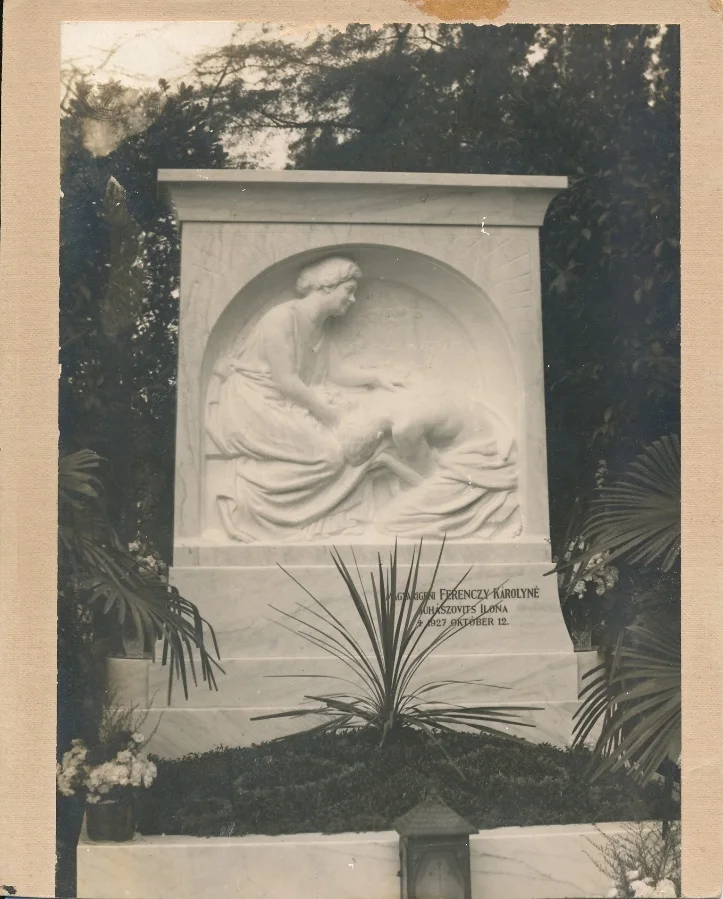
In the funerary monument of Ferenczy Károlyné, Bory Jenő placed the ideas of motherhood and family attachment at the centre, through a sensitively modelled marble relief.
The funerary monument of Magyarigeni Ferenczy Károlyné, in Plot 39 of Kerepesi úti Cemetery in Budapest, was made by Bory Jenő in 1929. The memorial is in white marble and stands approximately two metres high. Its central feature is a large-scale relief presenting the idea of motherhood.
Juhászovits Ilona (1872–1927), Magyarigeni Ferenczy Károlyné, is buried here. The central scene of the funerary monument shows a kneeling figure, above which is the intimate inscription “My darling”. The intimate composition expresses family remembrance and loving attachment, and differs from the allegorical or portrait-like solutions frequently employed by Bory. According to art-historical research, the funerary monument does not evoke the deceased through a direct portrait, but commemorates her by emphasising her maternal role and family relationships. Because of the sensitive human content of its delicately modelled marble relief, it may be counted among Bory Jenő’s most lyrical funerary monuments.
The funerary monument is now, regrettably, in a threatened condition. It stands in a less visited part of Kerepesi Cemetery and was covered by dense vegetation for a long time, which made its investigation and documentation difficult. Nevertheless, the relief still bears witness to Bory Jenő’s sensitive depiction of the human figure and to the high quality of his funerary sculpture.
It is noteworthy that Bory Jenő also designed a funerary monument for the deceased’s husband. According to the sources, books and a bookcase in that composition refer to the deceased’s intellectual activity. Research also stresses that Magyarigeni Ferenczy Károlyné was not the wife of the painter Ferenczy Károly, although some sources have mistakenly claimed this.