


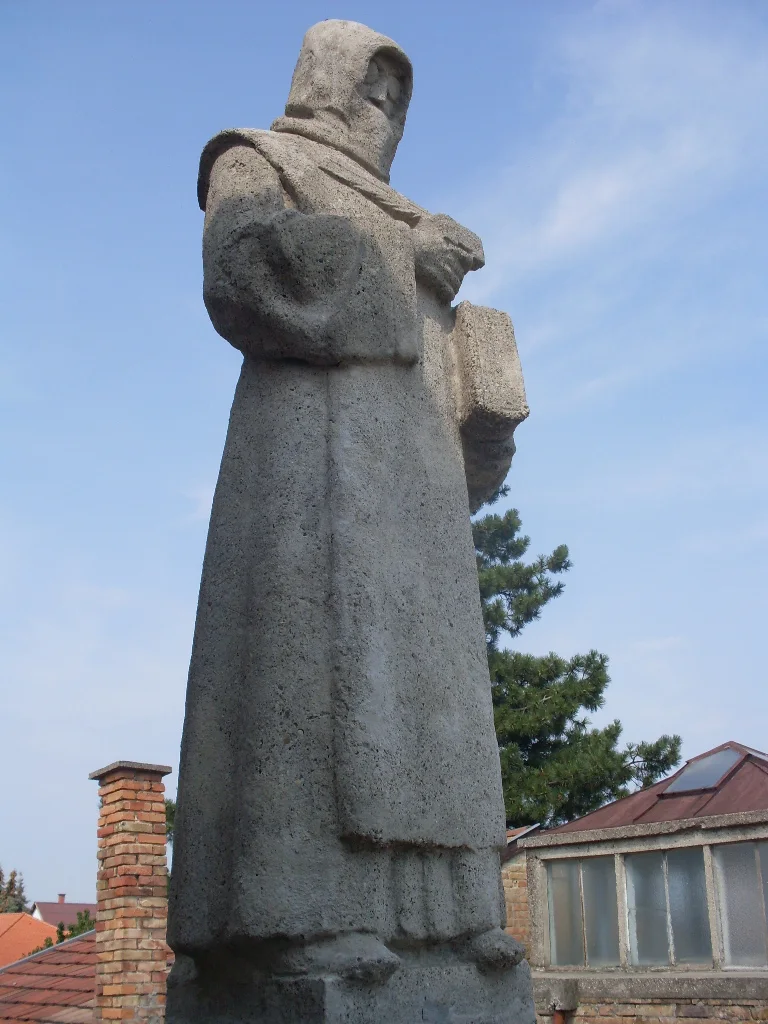
Among the figures in the historical arcade are not only kings and military commanders, but also those whose work preserved the memories of the Hungarian past. Anonymus, the best-known chronicler of medieval Hungarian historiography, belongs among them.
We know comparatively little about his person. In his work he revealed only that he was the notary of a King Béla, and identified himself merely as ‘Master P.’. For this reason, historical scholarship has not been able to identify him with complete certainty to this day. Tradition therefore simply calls him Anonymus, or ‘the Nameless One’.
His name is associated with the Gesta Hungarorum, the chronicle recounting the history of the Hungarian Conquest. His work was written at the turn of the twelfth and thirteenth centuries, and contains a significant part of the best-known narratives concerning the conquering Hungarians and the tribal chieftains. The names of Árpád, Előd, Ond, Kond, Tas, Huba and Töhötöm have survived in Hungarian historical memory largely through his writings.
In Bory Jenő’s statue, Anonymus appears in monastic dress, holding a book in his hand. The restrained figure of compact form evokes not the active hero, but the learned chronicler. The book refers to the work of the historian, the activity through which the traditions of the Conquest and many stories of the Hungarian past have been preserved for posterity.
The presence of Anonymus in the historical pantheon at Bory-vár is a reminder that national memory was not shaped by rulers and military commanders alone. Those who recorded the stories of the past and handed them down to the following generations also played a defining role in preserving it.