


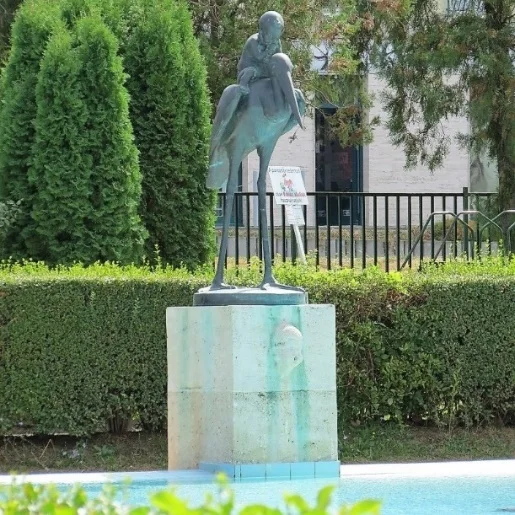
Birth of a Hussar is one of Bory Jenő’s most inventive and cheerful works. In a playful form, the work brings together popular imagination concerning the birth of a child and the figure of the Hungarian hussar: the hussar is not delivered in the stork’s beak, but the child is already riding upon the bird’s back.
This humorous idea makes the work both fairy-tale-like and immediately endearing. The first version of the composition was already shown at Bory Jenő’s exhibition at the Műcsarnok in 1922, on a small sculptural scale. The theme later developed into a life-size public work, and the piece became one of the artist’s best-known depictions of children.
One example of the statue stands near the children’s pool at the Csitáry G. Emil Swimming Pool and Lido in Székesfehérvár. It was probably placed in its present position in the mid-1930s, during the development of the new municipal lido. The composition was originally made as a fountain statue: child heads formed on the pedestal served as waterspouts, so the statue was also linked with the playfulness of water.
The other known example of the work is in Budapest, in the park before the obstetrics and gynaecology pavilion of Saint John’s Hospital. This public work was erected in 1937. According to the original plans it would have decorated one of the capital’s playgrounds, but it was eventually placed before the maternity unit, where its theme acquired a particularly apt meaning. The bronze statue stands in the centre of a rectangular pool, on a pedestal nearly two metres high; stone carvings depicting children’s heads were placed on the four sides of the pedestal and functioned as waterspouts.
From an art-historical perspective, Birth of a Hussar is a good example of the distinctive qualities of Bory Jenő’s depictions of children. The artist did not create an idealised allegory, but approached the theme with humour and imagination. The pairing of the stork and the hussar refers both to folk beliefs connected with the birth of a child and to the hussar figure that occupies a special place in Hungarian culture. The statue is therefore not merely a decorative public work, but also a record of the playful outlook of Hungarian sculpture between the two world wars.
The original plaster model of the composition may still be seen beneath the arcade of the Hundred-Column Courtyard at Bory-vár, where the artist preserved models of many of his public works. Visitors may thus follow the creative process through which an idea for a small sculpture became a public statue known throughout the country.