


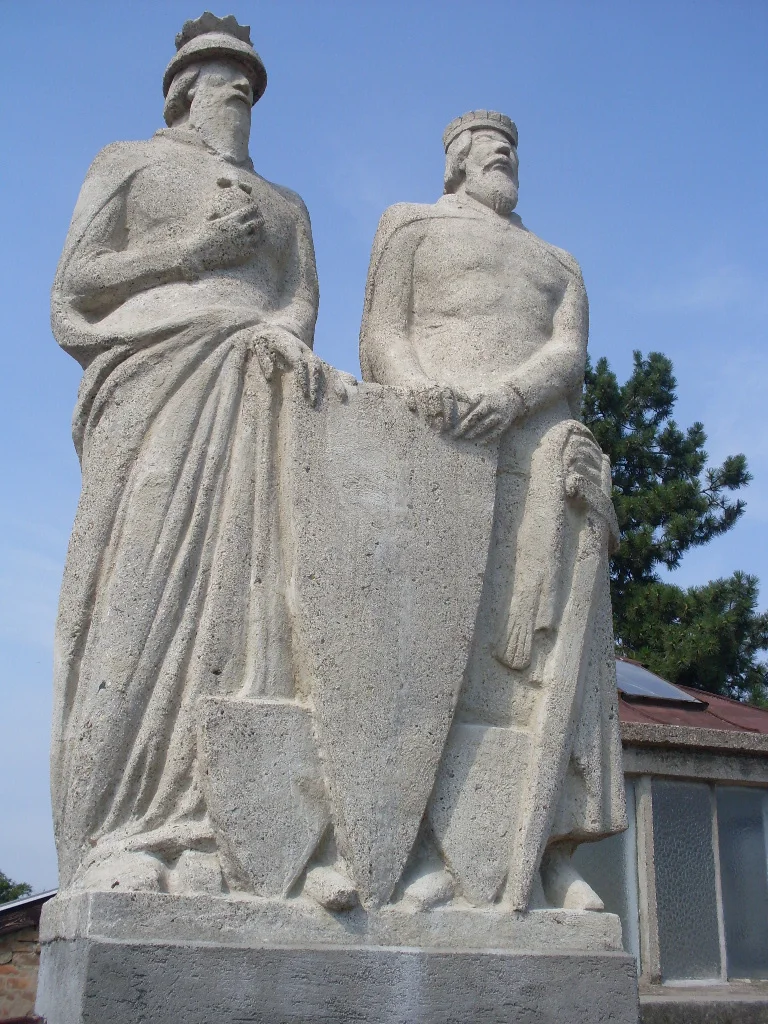
In the historical arcade, Charles Robert and his son, King Louis the Great, appear together. The father and son evoke one of the strongest periods of the medieval Kingdom of Hungary, when the country’s political standing and economic power grew considerably.
Charles Robert finally secured the Hungarian throne in 1308, following a prolonged struggle to break the power of the provincial lords. During his reign royal authority was gradually restored; he reformed the finances, supported the development of mining, and significantly increased the country’s revenues. He created political stability, which made subsequent development possible.
Beside him stands his son, Louis I, known to history as Louis the Great. He reigned from 1342 to 1382, and it was during his rule that the European influence of the Hungarian kingdom reached its height. Through his campaigns he gained prestige in the region, and for a time his dominion also encompassed the personal union of Hungary and Poland. In historical memory, his name became associated with the ideal of the knight-king and the figure of the just ruler.
Bory Jenő portrayed the two kings side by side, above a shared heraldic shield. The composition emphasises dynastic continuity: the son inherited the country consolidated by his father and, building upon it, carried the kingdom forward. The figures’ similar scale and authoritative modelling suggest that their historical roles are closely interwoven.
The sculptural group commemorates two defining rulers of the Angevin period. Following the line of the Árpád dynasty, which ends in the arcade with Andrew III, their figures symbolise the new age in which the Hungarian kingdom once again possessed strong central authority and considerable international weight.