


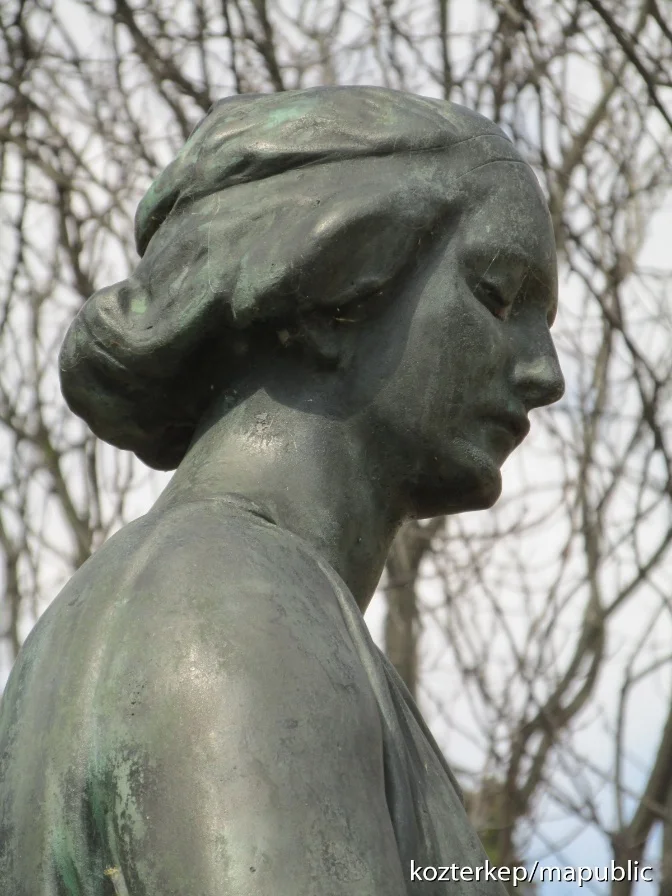
Among Bory Jenő’s First World War memorials, a prominent place is occupied by the work commemorating former pupils of the Székesfehérvár Higher Commercial School. It stands on Várkörút, in the park beside the Zsuzsanna Spring, where it still preserves the memory of students who fell in the Great War.
The association of the school’s former pupils initiated the memorial in December 1927. A wide-ranging fundraising campaign followed: contributions from former students, companies, financial institutions and private individuals raised almost 6,000 pengő for its execution. The work was originally intended for the school courtyard, but on Mayor Aladár Zavaros’s proposal it was placed in front of the school in public space, so that it could be readily seen by city residents.
The ceremonial unveiling took place on 2 June 1929, combined with the 60th anniversary of the Higher Commercial School and the 75th anniversary of the foundation of the commercial apprentices’ school. City and county leaders, military and ecclesiastical dignitaries, and the school’s teachers and pupils attended. Speeches, recitations and musical performances accompanied the unveiling, paying tribute to the students who had died heroically.
The central figure is a 185-cm bronze female figure holding a laurel wreath in one hand and a sword in the other. It may be read as a symbol of victory, remembrance and sacrifice. Pál Bory cast the bronze statue in his Székesfehérvár workshop, while Bory Jenő made the stone base and its carved details. A relief of a dying student-soldier on the front of the base directly refers to the fallen former pupils.
The base originally bore the inscription ‘To the former pupils of the Higher Commercial School who died heroically’, while the reverse was inscribed with Mihály Vörösmarty’s well-known line: ‘It cannot be that so many hearts shed blood in vain.’ The names of 49 former pupils who fell in the First World War were also carved into the stone.
The memorial lost its original location in 1971, when it was moved to the park behind the Zsuzsanna Spring. It then received a smaller base, while the original list of names was placed on a separate stone plaque behind the statue. The work was restored several times over the decades, notably in 1996 and again in 2015–2016, when the sculpture was conserved and its surroundings landscaped.
The statue exemplifies the characteristics of Bory Jenő’s memorial sculpture. The allegorical female figure, the relief of the heroic dead and the carefully formed architectural frame carry at once the ideas of mourning, remembrance and national steadfastness. The work commemorates not only the war’s 49 victims, but the loss of a whole generation that passed from the school bench to the battlefield.