


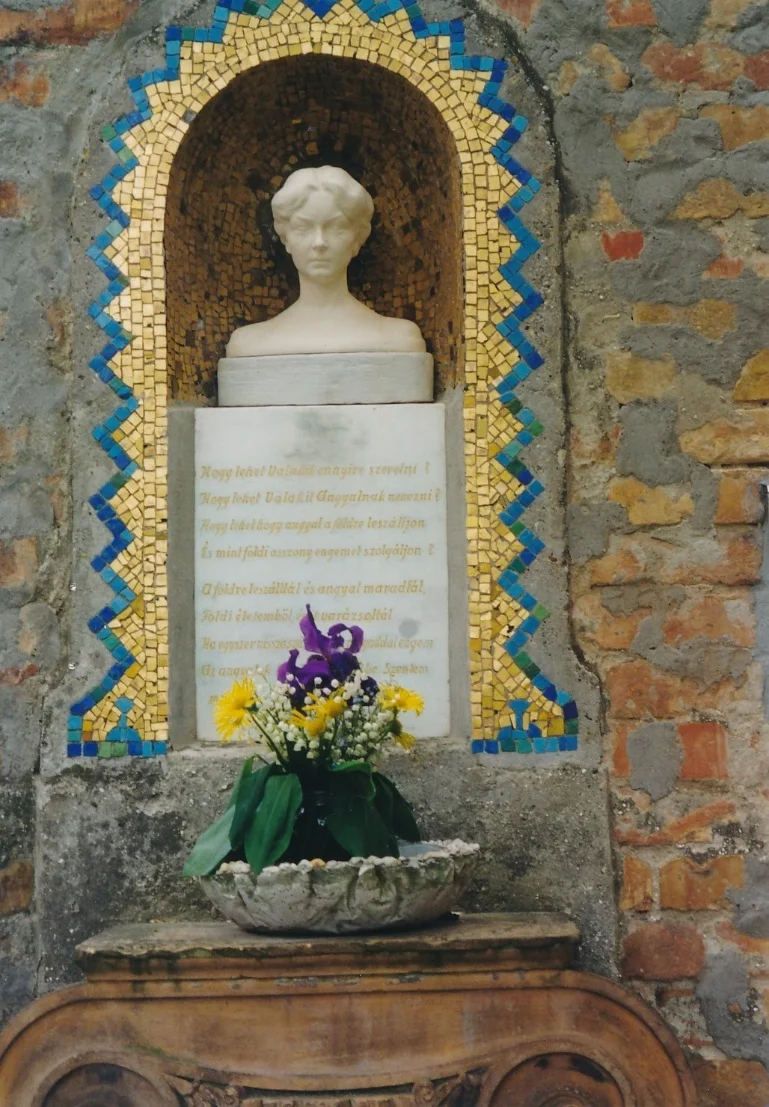
In the sculpture niche formed to the left of the Picture Gallery entrance, visitors are greeted by a portrait of Bory Jenő’s wife, Komócsin Ilona (Mrs Bory).
Above the 25 cm-high ceramic sculpture, a background of gold and blue mosaic gleams, while beneath it one may read one of Bory Jenő’s most personal declarations. Together, portrait and poem create a unity: they preserve not only the memory of Komócsin Ilona, but also evoke the deep emotional and creative alliance from which the idea and spirit of Bory Castle were born. The lines of the poem bear witness to a love lasting a lifetime:
“How can one love someone so deeply,
how can one call someone an angel,
how can it be that an angel descends to earth
and, as an earthly woman, serves me.
You descended to earth and remained an angel,
you transformed my earthly life into a heavenly one.
Should you one day fly back, take me with you,
and plead for me among the angels, my saint.”
In the poem, Bory Jenő evokes his wife as an angel, who through her presence gave his life not only happiness but also a higher meaning and beauty. The lines are at once intimate and playful, while also bearing witness to deep faith and togetherness. Bory Castle as a whole is also interpreted as a monument to conjugal love, and in this sculpture niche the idea becomes especially tangible. The calm simplicity of the portrait, the almost sacred atmosphere of the mosaic niche and the poem’s personal voice together create a memorial that transcends traditional portraiture.
Fresh flowers are always placed before the sculpture. Komócsin Ilona adored flowers, so they suggest that the portrait is not merely the memory of a figure from the past, but part of the still-living story of Bory Castle. This modestly sized ceramic portrait is therefore significant not chiefly as an artistic representation, but because it carries one of the castle’s most human messages: the love from which both Bory Jenő’s creative world and Bory Castle itself were born.