


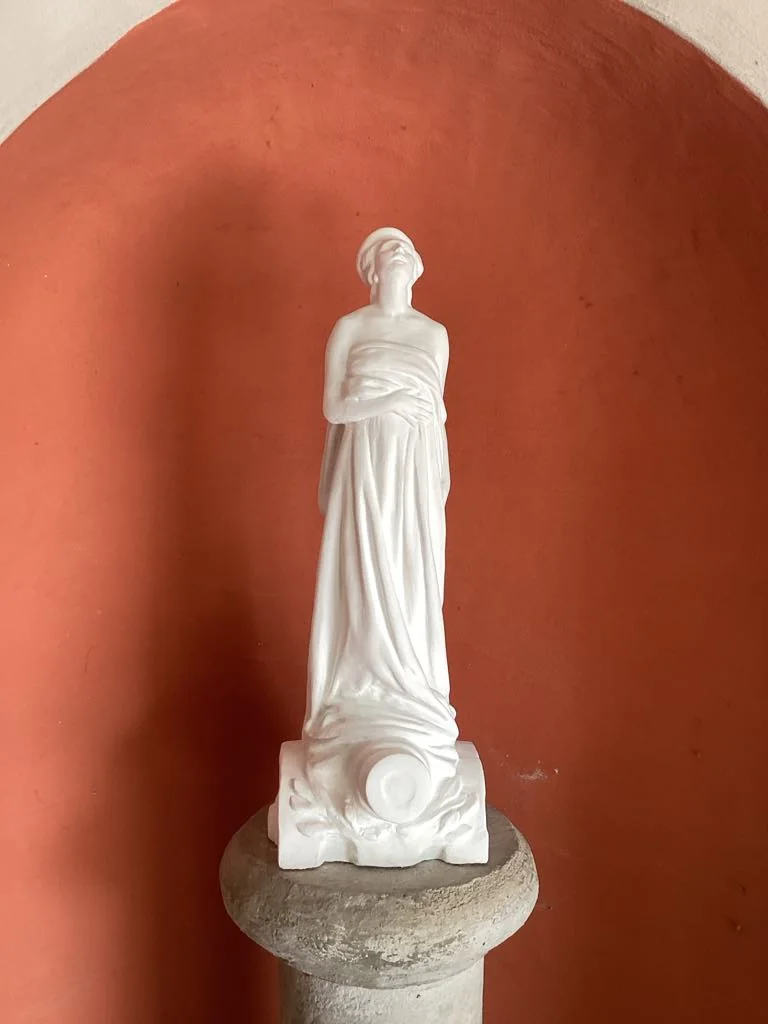
The figure of Saint Barbara belongs to Bory Jenő’s series of sculptures on Christian subjects. The artist portrayed the patron saint of artillerymen, miners and other dangerous occupations in a manner that is elevated yet humanly immediate.
The statue represents a slender female figure clad in a long, folded garment. She raises her head towards the heavens, her gaze directed upwards, and her bearing is calm and dignified. The carefully modelled drapery and harmonious proportions are characteristic features of Bory Jenő’s mature sculptural style. The work does not depict the dramatic event of martyrdom, but stresses the spiritual strength and inner calm born of faith.
According to Christian tradition, Saint Barbara was shut in a tower by her pagan father to isolate her from the outside world. Barbara nevertheless embraced the Christian faith and suffered martyrdom for it. She therefore became a symbol of steadfastness and profession of faith. The saint’s best-known attribute is the tower, clearly recognisable on the base of one surviving version of the sculpture.
Old studio photographs show that Bory Jenő made several versions of the composition. One statue appears with the traditional tower attribute, but another stands upon a cannon barrel. This solution is especially noteworthy, as it directly refers to Saint Barbara’s role as a patron saint. In Hungarian tradition, Barbara is the patron of artillerymen, miners, bomb-disposal specialists and others in hazardous occupations, and the Hungarian artillery still venerates her as its patron saint. The cannon base is therefore not simply decorative, but a deliberate iconographic reference to the saint’s cult.
Versions were made with cloud bases and with plain pedestals, as Bory considered a range of final settings and executions. These variants clearly convey his creative method: he enriched the same basic composition with different symbolic elements according to which aspect of the saint’s legend or veneration he wished to emphasise.