


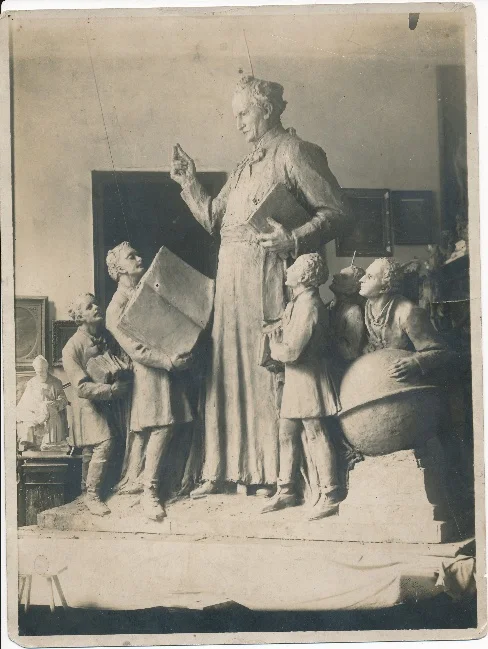
The two sculptural groups on the façade of the Piarist Grammar School in Kecskemét represent the dual ideal of Piarist education: formation in Christian faith and the transmission of scholarly learning.
The Piarist Grammar School in Kecskemét was built between 1930 and 1933 to designs by Dezső Hültl. The allegorical groups on the building’s outer cornices were made by Bory Jenő in 1933. The central figure of both compositions is Saint Joseph Calasanz (1557–1648), founder of the Piarist Order and heavenly patron of Christian schools. The sculptures express the fundamental principle of Piarist education: faith and knowledge as complementary forces in human formation.
In the Ecclesiastical Teaching group on the left side of the building, Saint Joseph Calasanz raises a cross before the young people standing around him. The cross symbolises Christian faith, moral education and preparation for a religious life. The composition stresses the spiritual and religious mission of Piarist pedagogy.
In the Secular Teaching group on the right, the saint holds a book. Here the emphasis is on the sciences, the acquisition of knowledge and the transmission of learning. The book is a symbol of study, education and human knowledge, referring to the Piarist Order’s centuries of teaching activity.
In the two works Bory Jenő presented faith and science not as opposing but as complementary values. The groups are therefore not only ornaments of the school building but sculptural summaries of the Piarist educational programme. Ecclesiastical Teaching and Secular Teaching are significant works of architectural decoration in Bory’s oeuvre, clearly exemplifying his ecclesiastical art, in which religious content and educational purpose are closely joined.