


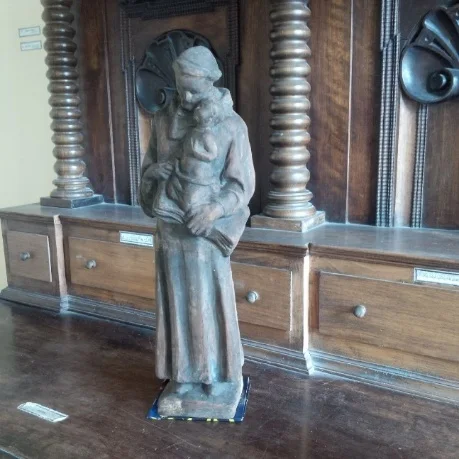
Bory Jenő’s statue of Saint Anthony of Padua can be found in several locations. One Carrara-marble version of the composition stands in the forecourt of the Prohászka Ottokár Memorial Church in Székesfehérvár, while its mirror-image counterpart is displayed in the Cathedral of the Assumption (Nagytemplom) in Kaposvár. The original plaster model is preserved at Bory-vár in Székesfehérvár, making it possible to trace the making of the sculpture.
The statue depicts the popular Franciscan saint with the Christ Child seated in his arms. Wearing a friar’s habit, Saint Anthony tenderly embraces the child with one arm and holds a book in the other, alluding to his proclamation of the Gospel and his work as a preacher. The movement of the two figures towards one another creates an intimate, humanly immediate relationship.
A particular feature of the work is that it is the mirror-image version of Bory’s Saint Anthony statue in the Cathedral of the Assumption (Nagytemplom) in Kaposvár. The composition survives in several locations: beside the marble statue in Székesfehérvár, the original plaster model may also be seen at Bory-vár, offering a rare opportunity to study the genesis of the work.
The material of the statue, Carrara marble, is of particular importance in Bory Jenő’s oeuvre. The artist learned the craft of marble carving during his study trip to Carrara, Italy, and later applied this knowledge in many ecclesiastical works. The delicately worked draperies, soft forms and sensitive treatment of the marble reflect the artist’s mature sculptural skill.
The Saint Anthony statue exemplifies one of the most important characteristics of Bory Jenő’s church art: an affectionate, humanly immediate treatment of religious subjects. Rather than monumentality or spectacular miracle, the work foregrounds the intimate bond between the saint and the Christ Child, which carries its principal emotional message.