


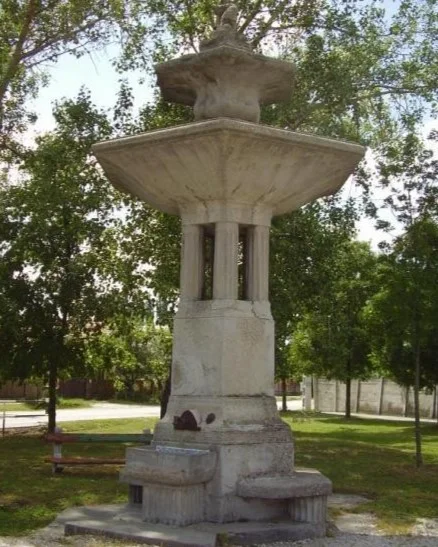
The Saint George Fountain is among Bory Jenő’s early public works and clearly exemplifies the artistic approach in which sculpture, architecture and engineering thought are united.
The artist gave many signs of his gratitude towards Székesfehérvár, his native city: having been able to pursue his studies as a scholarship holder of the city, he later enriched its public spaces with several works. Following the two mosaic-decorated vases, the Saint George Fountain was completed in 1922 and originally placed in Zichy Grove, behind the statue of the Holy Trinity.
At the top of the fountain is Saint George defeating the dragon. One of the best-known scenes of Christian iconography appears here: the Roman soldier and martyr saint acts as a symbol of victory over evil. Bory formulated the scene concisely, concentrating on its essence. The sculptural group does not seek detailed narrative, but emphasises the symbolic content of struggle and victory.
The work’s distinctive character originally derived not only from its sculptural solution, but also from its role as a functioning fountain. Beneath the upper section bearing Saint George were two reinforced-concrete basins. Water splashed from the upper basin to the lower one, then into the fountain basin, before a pump raised it back to the highest level, ensuring a continuous water display. The fountain also served as a drinking fountain, thereby uniting artistic and practical functions.
Over its history, the fountain has stood in several locations. In the early 1960s it was moved from Zichy Grove to Barátság Grove. It continued to operate there for a long time, but later lost its water function and gradually deteriorated. During its restoration in 2023–2024, the master stone carver Pál Nyakas restored the work, which was then moved to a new location in Illyés Grove, at the junction of Berényi út and Tompa Mihály utca. At its new location, it no longer functions as a fountain but as a public work of heritage value.
The work is also an early example of Bory Jenő’s experiments in concrete architecture and concrete sculpture. For the artist, concrete was not merely a structural material, but also an independent means of artistic expression. The Saint George Fountain embodies this approach: it is at once an engineering work, a decorative public fountain and a symbolic sculpture.