


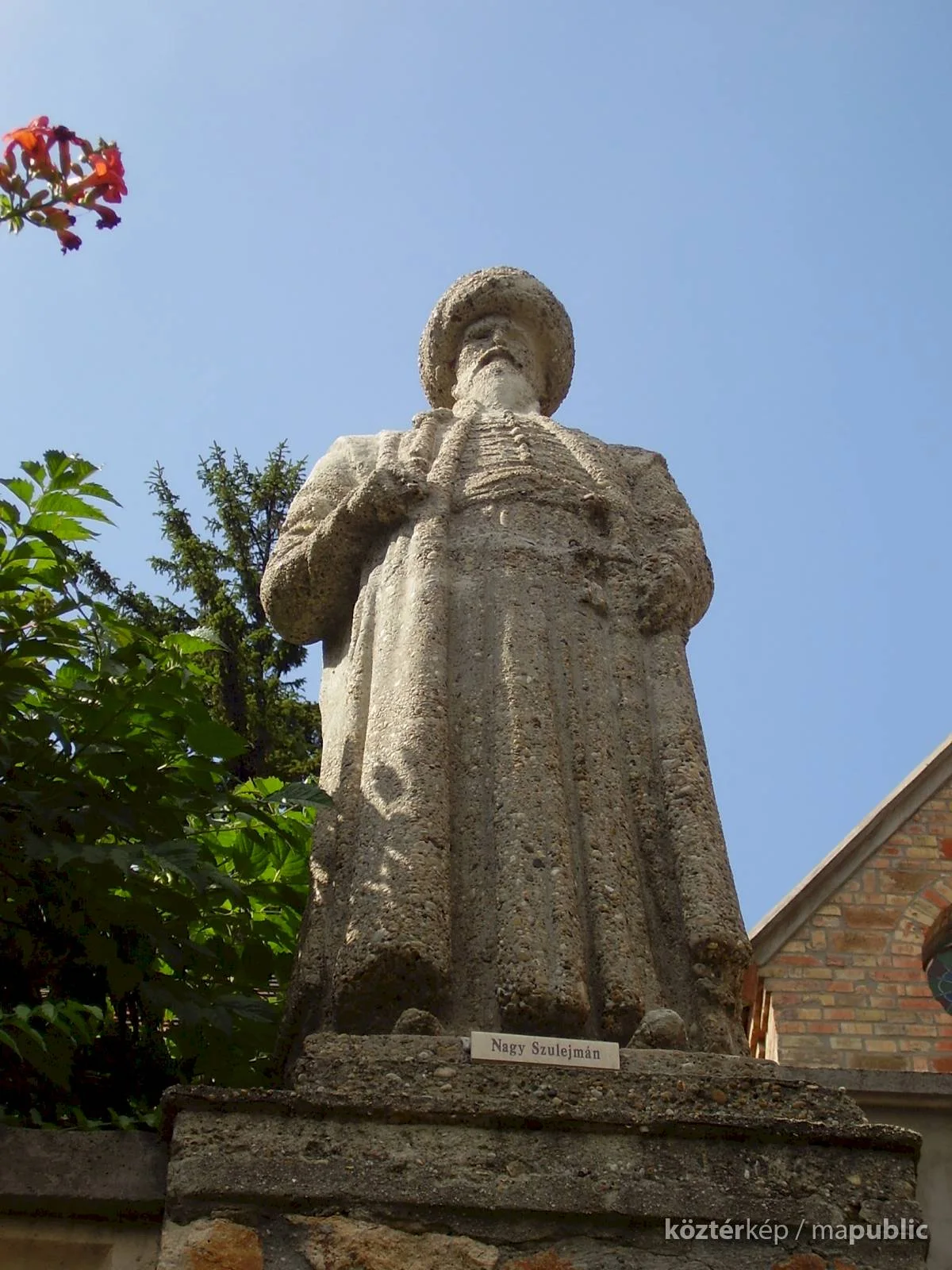
On the parapet of the Elephant Courtyard at Bory-vár, among figures from Hungarian history, there is, surprisingly, also a statue of the Ottoman sultan Suleiman the Magnificent.
- Quartz concrete, 190 cm, Bory-vár
- Hand-painted Herend porcelain, 26 cm, Herend Porcelain Museum, Bory-vár
- Ceramic, 48 cm, Bory-vár
At first sight the choice may seem unusual, since Suleiman was not a figure in Hungarian history but one of its most significant adversaries. Yet in his view of history Bory Jenő wished to present not only Hungarian heroes, but also those personalities who shaped the fate of Hungary over the centuries.
Suleiman I (1494–1566) was among the greatest rulers of the Ottoman Empire. The capture of Nándorfehérvár, the Battle of Mohács and the seizure of Buda are associated with his name. During his reign the empire reached its greatest extent and became a decisive power in Central Europe for a long time. In Hungarian historical memory, his name is associated above all with the era of Ottoman conquest.
In Bory Jenő’s statue, the sultan appears in a dignified, calm pose. He wears a long kaftan and the characteristic high Ottoman headdress, and holds a sword in his hand. The work does not depict an enemy, but a ruler of historical importance. The artist avoided a martial or threatening treatment; Suleiman’s figure instead conveys sovereign authority.
The statue also has a distinctive later history. In collaboration with the Herend Porcelain Manufactory, Bory Jenő also created a porcelain version based on the composition. The finely modelled, richly painted Herend figure is among the artist’s porcelain works on historical themes. The small-scale sculpture and the monumental concrete version visible at Bory-vár show well Bory’s endeavour to represent the same historical figure in different scales and materials.
At Bory-vár today, one may encounter both the large quartz-concrete statue of the sultan and the Herend version that evokes the world of porcelain art. A pyrobasalt version of the statue was shown at the exhibition held at the Műcsarnok in the middle of 1926.