


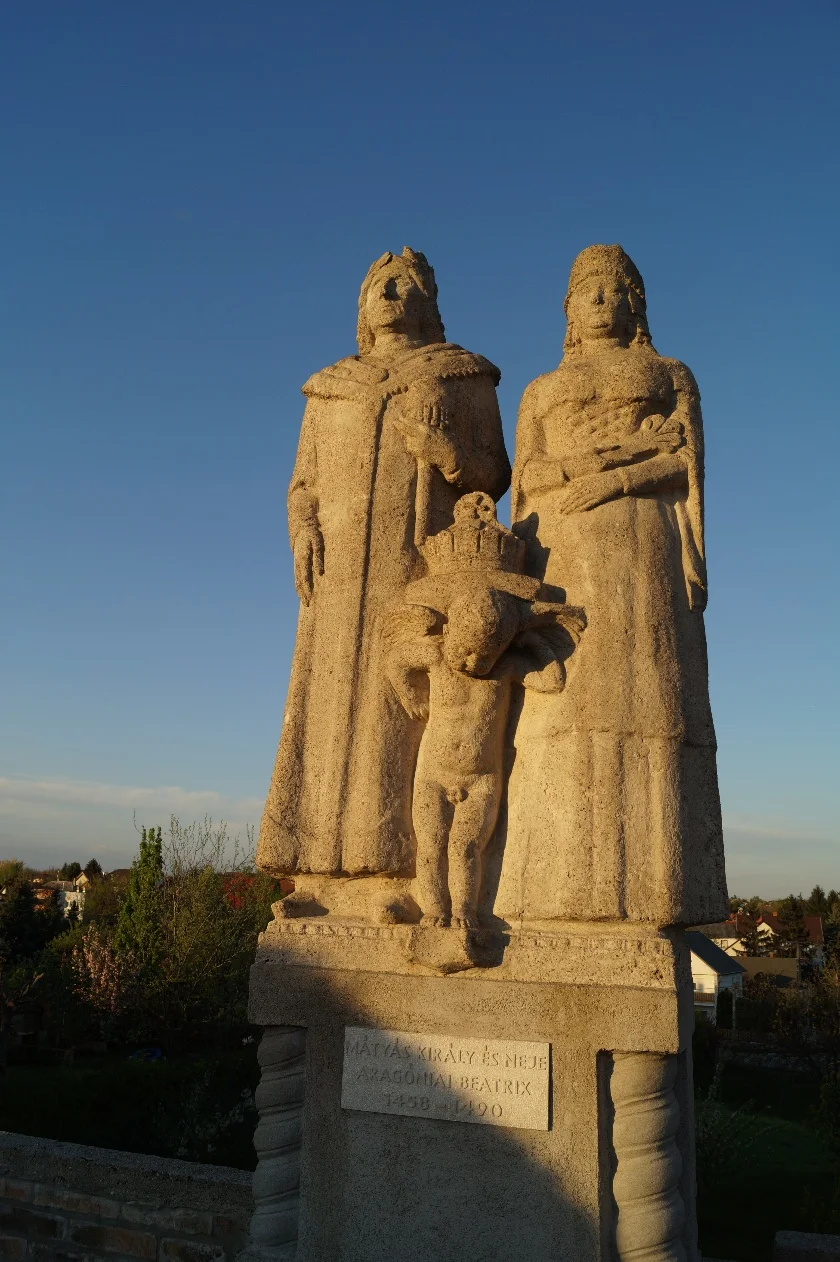
One sculptural group in the historical arcade depicts Matthias Hunyadi and his second wife, Queen Beatrix of Aragon. The royal couple evokes the Hungarian kingdom of the second half of the fifteenth century, when alongside the country’s political standing, courtly learning and Renaissance culture also underwent considerable development.
King Matthias reigned between 1458 and 1490. He came to the throne as the son of Hunyadi János, and during his reign strengthened royal power, reorganised the administration and created one of the best-known mercenary armies of the age, the Black Army. Through his foreign policy, Hungary became a decisive power in Central Europe.
His wife, Beatrix of Aragon, arrived in Hungary from the Neapolitan royal court in 1476. Their marriage was not only a dynastic alliance, but also had a significant cultural impact. With Beatrix’s involvement, Italian connections grew stronger, and Renaissance art and scholarship increasingly gained ground at the royal court in Buda. The new intellectual currents also appeared in architecture, courtly representation and the development of the celebrated Bibliotheca Corviniana.
In Bory Jenő’s statue, the king and queen stand side by side, with an angelic figure rising between them. The composition stresses the idea of marriage and royal unity. The figures’ ceremonial, tranquil bearing does not portray a historical event, but evokes the period when the Hungarian royal court became an important centre of the European Renaissance.
In the historical arcade, the group of Matthias and Beatrix appears as a symbol of state power, learning and cultural openness. The sculptural group recalls the time when the Hungarian kingdom stood out in Europe not only through its political and military standing, but also through its cultural achievements.