


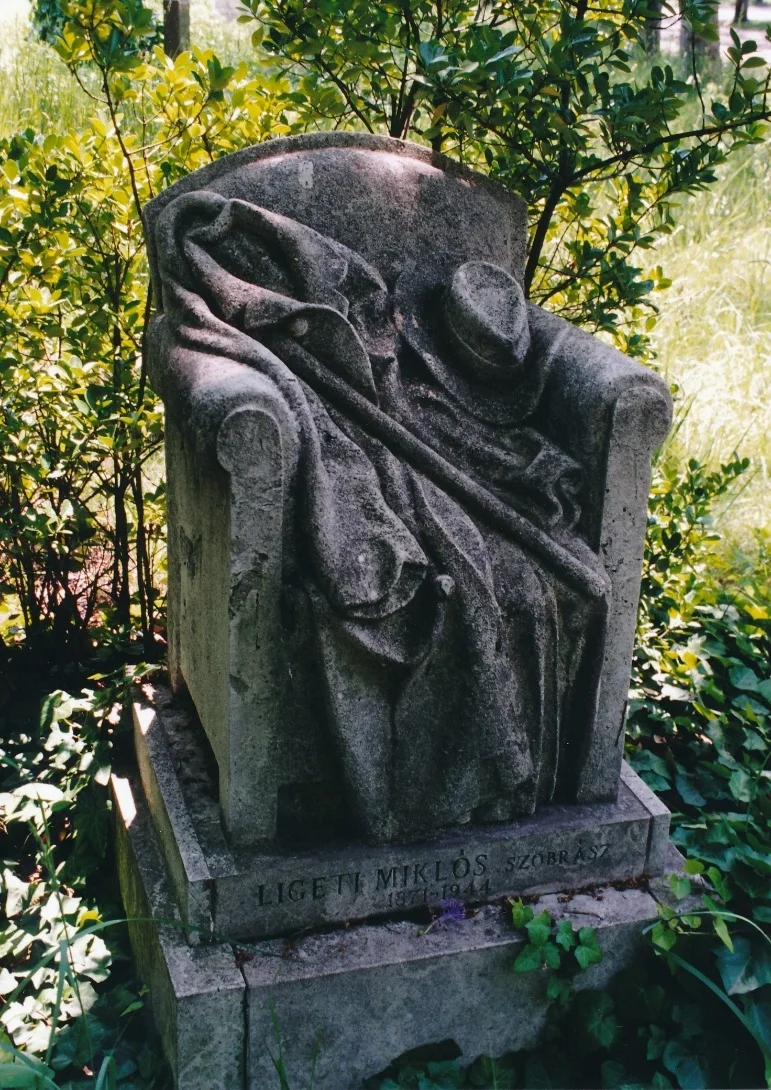
The funerary monument of Ligeti Miklós is a distinctive work of Hungarian funerary sculpture: it evokes the deceased sculptor not through a portrait, but through his objects left empty.
Ligeti Miklós (1871–1944), a sculptor, was one of the important Hungarian artists of the first half of the twentieth century. His name is associated with numerous public statues and memorials; among his best-known works is the statue of Anonymus in City Park, Budapest.
His funerary monument in Kerepesi úti Cemetery was made by Bory Jenő in 1944. The memorial is unusual in that it represents neither the deceased’s face nor his figure, but an empty armchair on which an overcoat, hat and walking stick have been placed. Through these abandoned personal objects, the composition evokes the artist’s figure and absence.
The funerary monument, made from quartz concrete, is one of Bory Jenő’s most original works of funerary sculpture. The statue alludes to both passing and remembrance: the objects left behind fill the place of the human figure absent from the chair. This symbolic solution is rare among Bory’s funerary monuments, which are otherwise characterised more by the use of portraits and allegorical figures.
The history of the memorial’s creation is only partly clear. According to the sources, Ligeti Miklós originally wished for a copy of the Anonymus statue on his funerary monument, but owing to the circumstances of the war years this symbolic composition was ultimately placed on the grave. The work thus preserves not only the memory of an outstanding sculptor, but is also a unique and thought-provoking example of Hungarian funerary art.