


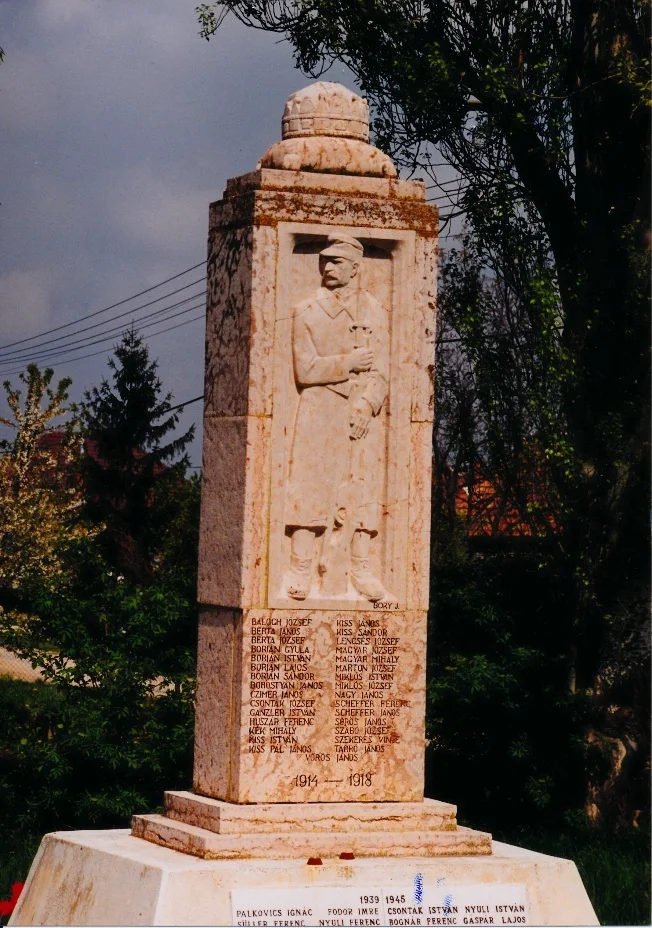
On 27 August 1937, the representative body of Kőszárhegy resolved to erect a fitting memorial to the village’s war dead.
The organisational work was entrusted to teacher Vitéz István Szabó, whose task was to secure the funds, select the memorial and prepare its execution. Local solidarity was exemplary: donations raised 1,500 pengő, while residents contributed cartage, manual labour and day work. The village eventually chose Bory Jenő’s work. It was ceremonially unveiled on 25 June 1939; the event’s importance is shown by the attendance and ceremonial address of Royal Prince József.
The memorial’s central feature is a soldier relief made of red marble. The soldier appears holding his weapon close, in a calm, dignified pose. Rather than the heat of battle, the composition stresses the elevated remembrance of sacrifice. A Hungarian crown appears at the top of the architectural setting, while the base bears the names of local heroes fallen in the First World War.
In later decades the memorial acquired an additional layer of meaning. Second World War memorial plaques were placed on it, and it now preserves the memory of local victims of both world wars. The memory of the two wars is thus joined in a single shared site of remembrance for the community of Kőszárhegy. The memorial remains important to village life in the twenty-first century. Under the centenary memorial-restoration programme, the municipality received support to restore the work in 2016–2017. Thanks to this restoration, Bory Jenő’s work still fittingly recalls the settlement’s heroes.