


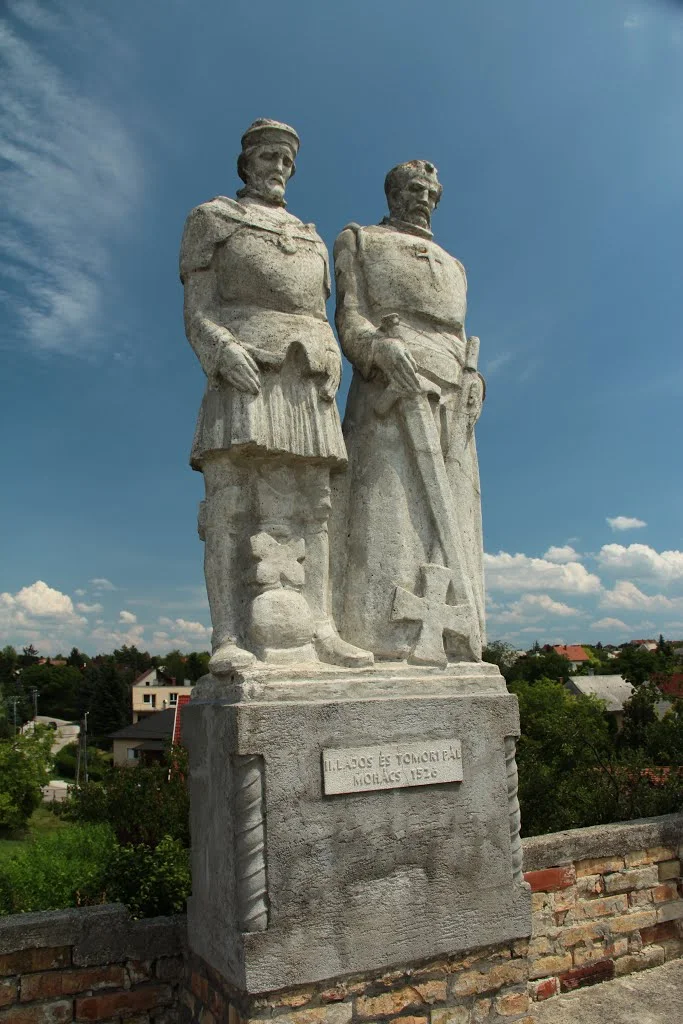
In the historical arcade, the figures of King Louis II and Pál Tomori recall the Battle of Mohács. Bory Jenő portrayed the young ruler and his military commander side by side, evoking the historical moment when Hungary faced one of the greatest challenges of the Ottoman conquest.
Louis II was born in 1506 and came to the Hungarian throne after the death of his father, Wladislaus II. During his reign, the Ottoman Empire exerted ever greater pressure upon the country’s southern borders. The king was only twenty years old when, in the summer of 1526, he took command of the Hungarian army in battle against the forces of Sultan Süleyman.
Beside him stands Pál Tomori, Archbishop of Kalocsa and military commander, who had warned of the approaching danger even before the Turkish attack. He proposed strengthening the southern defensive lines, but the necessary preparations were not made in time. During the campaign he assumed command of the Hungarian army and fell on the battlefield at Mohács.
The sculptural group shows the two figures in a calm, disciplined bearing. It conveys not the heat of combat, but the responsibility they had undertaken and the weight of approaching tragedy. The king and his commander appear together as participants in the same historical fate.
The defeat at Mohács occurred on 29 August 1526. Pál Tomori died in the battle, while Louis II lost his life during the retreat near the Csele stream. His body was later found by the men of János Szapolyai, taken to Székesfehérvár and buried in the royal basilica. Bory Jenő’s work therefore commemorates not only two historical figures, but also the event that marked a watershed in Hungarian history.