


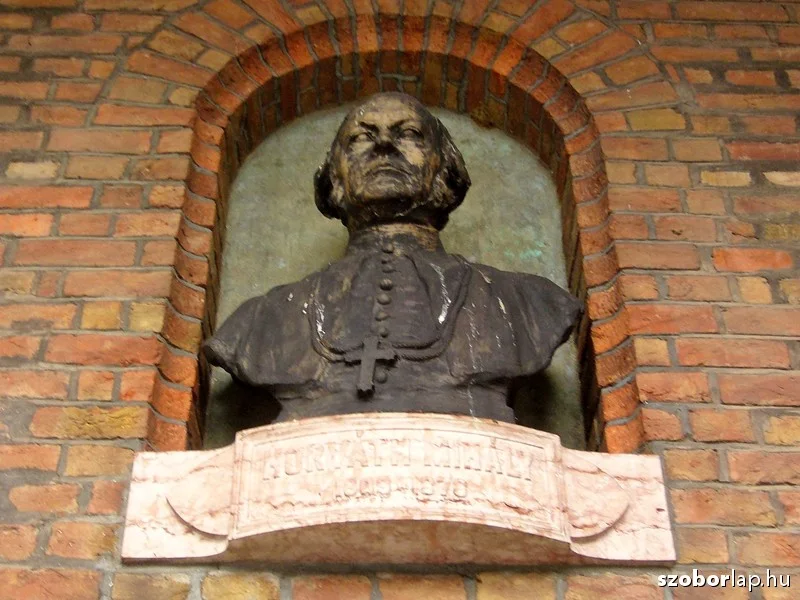
Bory Jenő’s bust of Horváth Mihály was made as part of the pantheon in Dóm Square, Szeged. The work commemorates one of the defining figures of nineteenth-century Hungarian historiography and public life, who played a significant role in Hungarian national development as a historian, Catholic bishop and politician alike.
The sculpture was made in 1930 and may still be seen in the eastern arcade of Dóm Square in Szeged, as part of the Nemzeti Emlékcsarnok. Bory Jenő also made two other portraits there: the busts of Szalay László and Toldy Ferenc.
Horváth Mihály (1809–1878) was a historian, Roman Catholic bishop and politician. He studied at the Piarist grammar school in Szeged and was ordained priest in 1831. He began his priestly service as a curate in Dorozsma, but later turned increasingly towards scholarship and public life. He became known above all through his historical writing. He was an important chronicler of the Reform Era and the War of Independence of 1848–49, treating the events of Hungarian national history in his works. During the revolution and War of Independence, he took an active political role, serving as Minister of Religion and Public Education in the Szemere government. Following the defeat of the War of Independence, he was forced into exile and could return to Hungary only after the Compromise. In 1867 he was elected Member of Parliament for one of Szeged’s constituencies, thereby returning to the country’s political life. Through his scholarly and public activity, he belonged among the defining personalities of Hungarian cultural and political life in the nineteenth century.
In Bory Jenő’s portrait, Horváth Mihály is seen in old age. The bust presents the scholar and churchman with calm dignity. The resolute features, concentrated gaze and restrained modelling emphasise the historian’s intellectual authority, while the portrait harmoniously joins the series of commemorative sculptures in the Dóm Square pantheon. The bust of Horváth Mihály preserves not only the memory of a significant historian and politician, but also recalls his connection with Szeged. The figure of the former Piarist pupil who became bishop, historian and minister has been given a place in the memorial hall of Dóm Square as an important representative of Hungarian national culture and historiography.