


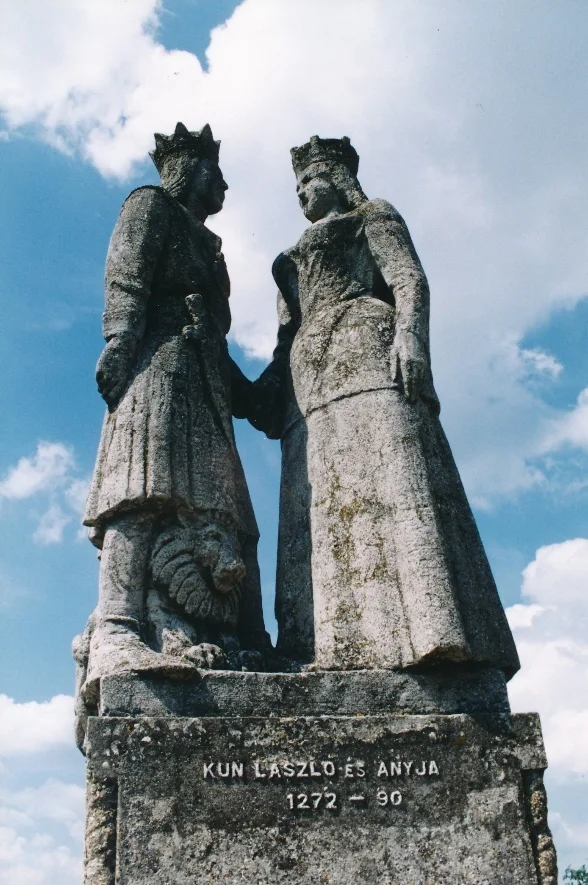
In the historical arcade, King László IV, known in history as László the Cuman, appears with his mother, the Cuman princess Erzsébet. Bory Jenő’s sculptural group refers to the close bond that linked the ruler to the Cumans throughout his life and shaped both his character and his reign.
László IV was the son of Stephen V, King of Hungary, and the Cuman princess Erzsébet. He received the epithet ‘the Cuman’ not because of his descent, but because as an adult he grew particularly close to the Cuman population settled in Hungary. From childhood he was caught up in political struggles: magnates seeking to increase their power abducted him in order to influence his father through him. Even after his accession he was unable to free himself from the pressure of baronial factions, and so increasingly sought refuge in the company of the Cumans.
László regarded the Cumans not merely as allies, but also adopted their way of life. This often brought him into conflict with the Hungarian magnates and the Church, who would have expected him to follow the ideal of a western Christian ruler. Throughout his reign he was compelled to balance constantly the interests of royal authority, the nobility, the Church and the Cumans.
In Bory’s statue, mother and son turn towards one another, as though representing the relationship that determined the king’s fate. The animal figure visible at the young ruler’s feet may refer to Cuman traditions and nomadic origins. At the centre of the composition is not power, but the question of identity: the bond between the king of the House of Árpád and his mother of Cuman descent.
The tragic end of László IV’s life further reinforces the dramatic content of the sculptural group. In 1290 he was murdered by the men of Cuman notables near Körösszeg Castle. His death brought to an end a singular life marked by continual political struggles and by navigating between two cultures. His contemporaries regarded him as a divisive ruler, but his figure conveys well the complex social and political circumstances of the end of the Árpád period.