


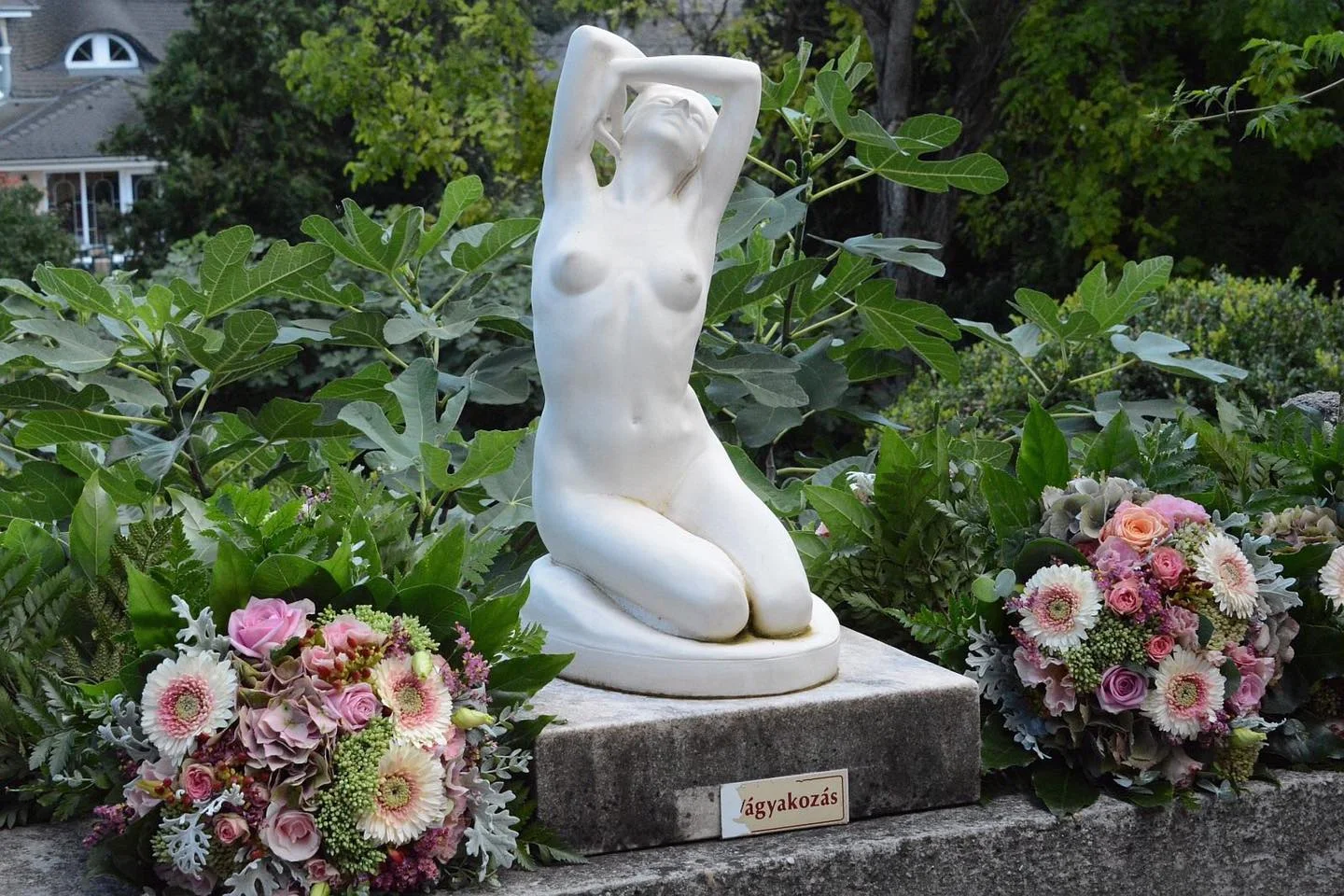
The sculpture entitled Longing was made in 1922 and became one of Bory Jenő’s best-known allegorical works. Its international recognition is demonstrated by the silver medal it received at the 1929 Barcelona International Exposition, where Hungarian fine art achieved notable success.
Beyond its idealised expression of female beauty, the work embodies the timeless human feeling of longing, of striving towards ideals and of unfulfilled desire. Bory Jenő was especially proud of this work: during his guided tours at Bory Castle, he would regularly pause before it and, with affectionate humour, draw visitors’ attention to it by saying: “this sculpture is a well-travelled lady”. By this apt remark, he referred to the work’s appearance at an international exhibition and to the recognition it brought its creator. The sentence also aptly reflects Bory’s personality: he regarded his creations not simply as works of art, but almost as living beings with stories of their own, whose histories and successes he kept in mind as he would those of a close acquaintance.
Extracts from the book Világkiállító magyarok [Hungarians at World Expositions], concerning the 1929 Barcelona International Exposition:
“The capital of Catalonia, one of Spain’s most important cities, had already held an international exposition in 1888. The 1929 event extended over 120 hectares on the outskirts of Barcelona, near the summit and on the city-facing slope of Montjuïc, which rises 213 metres above the coast.
After the loss of the First World War, the failed revolutions that followed, and the imposed peace treaty that severed two-thirds of its territory, Hungary was slowly recovering from the shock of Trianon by the end of the 1920s. The government decided to participate, and the representatives of our country achieved serious success despite limited financial means.
Because of the modest financial framework, the construction of an independent pavilion could not even be contemplated; instead, we were assigned a side wing of one of the great halls erected for foreign exhibitors beside the road leading to the stadium.
Our visual artists ranked second in the medal table:
Fényes Adolf’s Overcast Weather, Rudnay Gyula’s Resting Horses and Perlmutter Izsák’s Peasant Interior received grand prizes; Vadász Endre received first prize; while gold medals went to Koszta József’s Berekhát Windmill, one sketch for Tornyai János’s painting Entitlement, Iványi Grünwald Béla’s Gypsies, and Perlott Csaba Vilmos. Paizs Goebel Jenő, Bory Jenő and Count Batthyány Gyula received silver medals, while Varga Nándor Lajos was awarded a bronze medal for his etchings and graphic works. In addition, Csók István, Csánky Dénes, Hermann Lipót, Nádler Róbert, Morvay János and Karlovszky Bertalan received Honourable Mention.”