


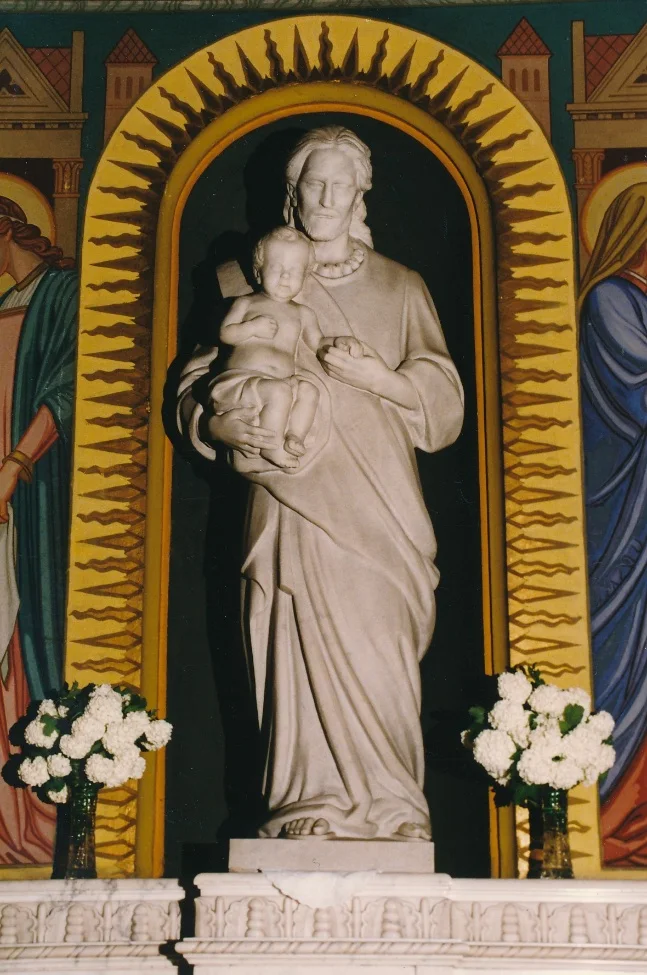
An important work of Bory Jenő’s ecclesiastical sculpture is the statue of Saint Joseph with the Christ Child, made in 1928 for the Cathedral of the Assumption in Kaposvár.
The work follows a familiar iconographic type in Christian art: it presents the foster father and child in an intimate relationship, stressing Saint Joseph’s protective and caring role.
The statue’s composition is characterised by calm and inner harmony. The figure, wrapped in long folds of drapery, holds the Christ Child in his arms and turns his gaze towards him. The relationship between the two figures is intimate and natural, free from excessive theatricality. Here Bory Jenő did not seek to stress the saints’ supernatural aspect, but their human closeness and emotional bond. The Christ Child nestles trustingly in Joseph’s arms, while the saint appears as the embodiment of loving providence. Bory Jenő’s classicising outlook is clearly visible in the work’s formal design. The figure is built from simple, compact masses, while the restrained rhythm of the drapery lends the whole composition a balanced character.
The cathedral in Kaposvár occupies an important place in Bory Jenő’s ecclesiastical work. Alongside the Saint Joseph statue, it contains the artist’s statue of Saint Anthony, an Immaculata representation, and the Saint Stephen ornamental fountain set into the church’s external wall. This ensemble demonstrates that Bory Jenő was a sought-after artist in Hungarian ecclesiastical sculpture during the interwar period.
The ceramic version preserved in the collection of Bory-vár offers visitors the opportunity to examine the work’s formal qualities at close range.