


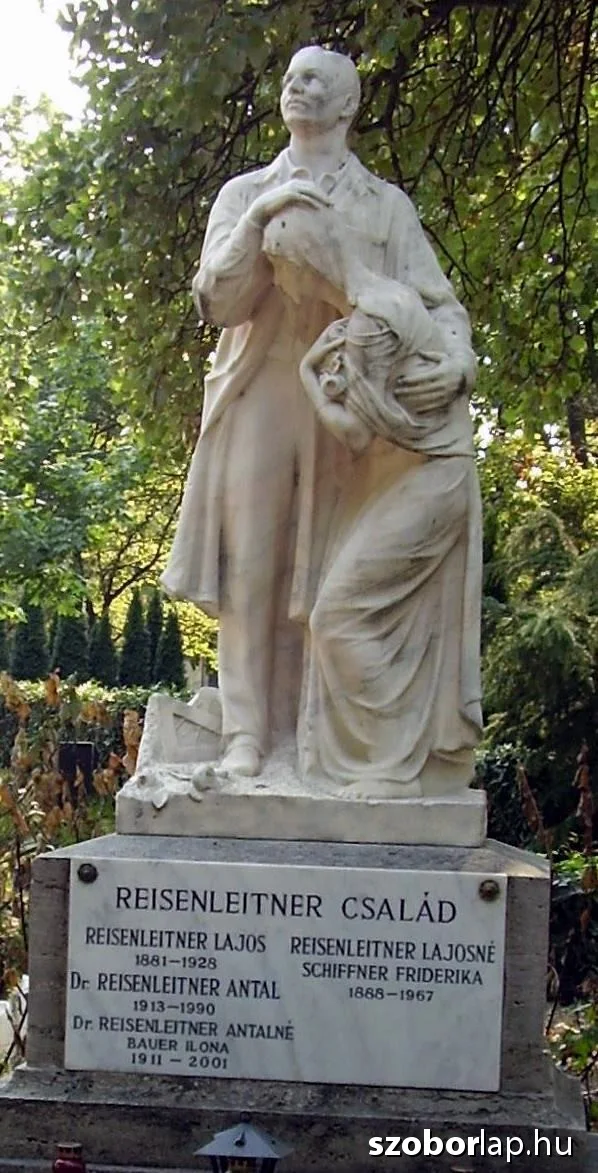
The funerary monument of Reisenleitner Lajos is among those works by Bory Jenő which preserve not only the memory of the deceased, but also refer in symbolic form to his profession and family relationships.
The Reisenleitner Lajos family funerary monument, in Plot 43 of Kerepesi úti Cemetery in Budapest, was made by Bory Jenő. Reisenleitner Lajos (1881–1928) was an architect, and the memorial was erected by his family in 1929 in his memory.
The central feature of the memorial is a white marble statue nearly two metres high, complemented by an architectural background of artificial stone 110 centimetres high. The composition shows a male and a female figure in a close relationship: the man embraces the woman protectively. The scene evokes family belonging, love and remembrance at once. A particularly interesting detail of the funerary monument is the pair of compasses and ruler at the male figure’s feet, traditional symbols of the architectural profession. These attributes refer directly to Reisenleitner Lajos’s occupation, so the composition may be understood not only as a family memorial but also as a symbolic representation of the deceased’s career.
Few biographical details of Reisenleitner Lajos have survived, which lends the funerary monument particular significance. Through symbols referring to his profession, Bory Jenő preserved the architect’s memory for posterity, emphasising the calling that shaped the course of his life. The Reisenleitner funerary monument is a fine example of one characteristic of Bory Jenő’s funerary sculpture: the combined representation of human relationships, family memory and an individual life. Through its harmoniously formed figures and the symbols of the architectural profession, the memorial becomes both a family site of remembrance and an enduring monument to a creative career.