


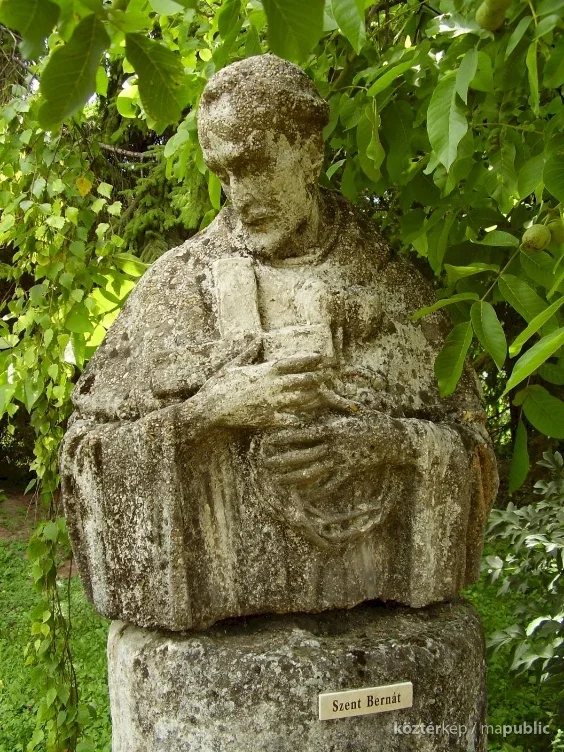
Among Bory Jenő’s ecclesiastical works, the statue of Saint Bernard occupies a special place, commemorating one of the most significant figures of the Cistercian Order.
Saint Bernard of Clairvaux (1090–1153) was a defining figure of the medieval Church, organiser of the Cistercian Order, and an exceptional orator and theologian. His work exerted such an influence upon his age that church history often calls part of the twelfth century the ‘age of Saint Bernard’. His holiness was recognised in his lifetime; he was canonised in 1174 and later named a Doctor of the Church.
The making of the statue is linked to the Cistercian community at Szentgotthárd. In 1934 Dr Imre Piszter, prior and a scholar of Saint Bernard’s life who had devoted several books to him, commissioned Bory Jenő to make the statue for the abbey. Made of white concrete, the work has a monumental effect at almost two metres high, while its restrained spirit accords well with the Cistercian tradition of simplicity. It portrays Saint Bernard in monastic dress, in a contemplative pose. In his hands he holds the instruments of Christ’s Passion. The composition includes the Cross, the crown of thorns and a distinctive staff which, according to tradition, recalls the sponge fixed to a reed with which Christ on the Cross was given drink. These attributes refer to Bernard’s deeply Christ-centred spirituality, a defining feature also of his writings and sermons.
The statue came to Székesfehérvár in 1999. Dr Béla Ágoston, Bory Jenő’s grandson, sought the consent of the Cistercian community at Szentgotthárd to move the work to a worthier and more accessible place. It had previously stood at the end of a secluded corridor in the monastery. It was eventually unveiled with due ceremony on 24 September 1999 at the Cistercian Saint Stephen Secondary School, where it remains a defining work in the building’s entrance hall.
Alongside the monumental statue, two smaller ceramic versions, 48 and 53 cm high, survive and are displayed in the Bory-vár collection. Also known are a 43-cm terracotta bust preserved by the Szent István Király Museum and a 100-cm quartz-concrete bust placed in the courtyard of Bory-vár. A further example stands in the garden of the Sacred Heart parish church at Baross Gábor-telep (Budapest, District XXII, Baross Gábor-telep, Dózsa György út 80).
The statue clearly exemplifies a fundamental quality of Bory Jenő’s religious art: in portraying saints, he placed spiritual content before outward display. In this work Saint Bernard appears as an enduring example of faith, learning, monastic discipline and devotion to Christ.