


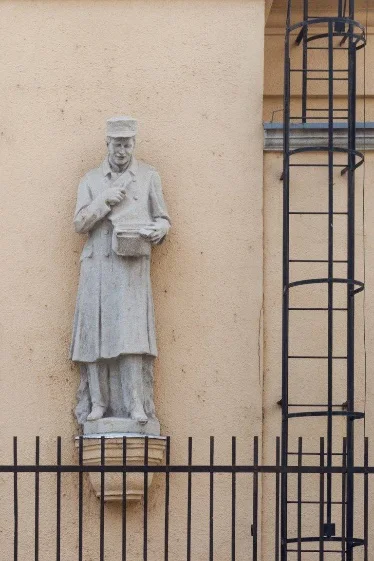
Among the lesser-known but particularly interesting works in Bory Jenő’s memorial sculpture and architectural decoration are the life-size figures placed on the exterior buttresses of the former BSzKRt bus garage in Budapest. The façade of the garage complex, built in 1930 and a significant achievement of Hungarian modern architecture and engineering, was adorned with figures personifying the actors of urban transport.
Bory Jenő’s statues depict not historical figures or mythological heroes, but characteristic people of everyday urban life: the driver, conductor, mechanic and female passenger. The works thus commemorate one of the period’s most important public services, metropolitan public transport. The allegorical figures present both those who operated and those who used transport, conveying the development that made Budapest a modern metropolis between the two world wars.
The former bus garage was built for the Budapest Metropolitan Transport Company (BSzKRt). It included not only vehicle storage but workshops, a filling station and an office building. Its central hall, with its enormous unsupported span, was an outstanding technical achievement of its age. Bory’s statues were suited to this modern architectural setting, making the building’s function readily recognisable by artistic means.
The group originally comprised five figures. Alongside the driver, conductor, mechanic and female passenger, a police constable appeared on the building, alluding to the maintenance of order in transport. This figure disappeared after 1945, so only the four surviving figures now recall the original composition’s completeness.
The bus garage ceased operating in its original function in 2000, but the complex survived because of its heritage value. Following renovation it acquired a new role as Récsei Center, while retaining many original architectural details. Bory Jenő’s sculptures remain in place, recalling a significant period in the capital’s development as distinctive monuments of Hungarian transport history and interwar public sculpture.