


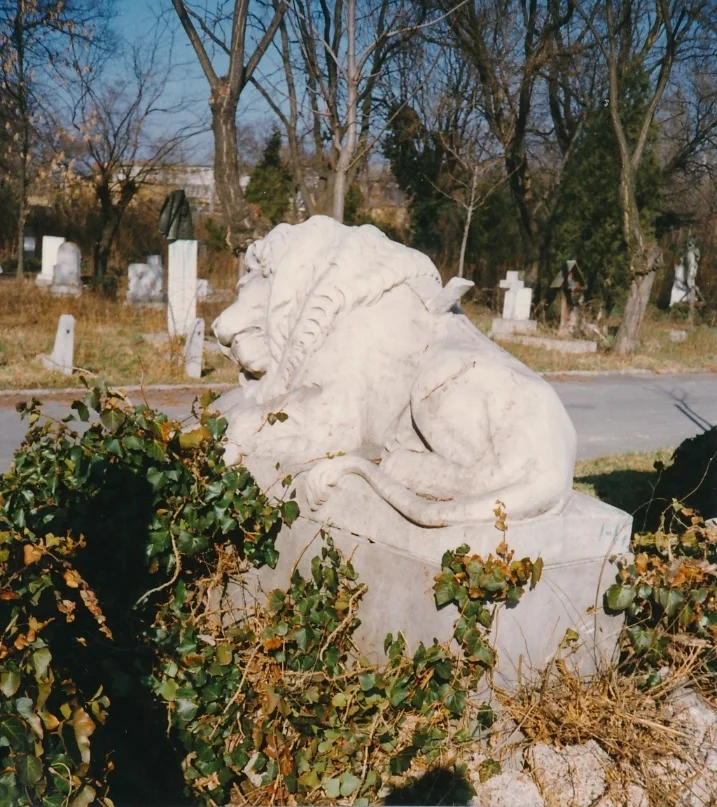
The Sleeping Lion at Bory-vár and the stabbed lion at Kerepesi Cemetery are two versions of the same memorial idea: one is a symbol of repose, the other of human struggle broken but retaining its dignity.
The Sleeping Lion visible near the entrance to Bory-vár is one of Bory Jenő’s well-known animal sculptures. The concrete statue depicts a lion resting peacefully, receiving the visitor almost as a guardian. Its outstretched paws, mane falling over its head and calm appearance evoke traditional motifs of garden sculpture.
The work is connected with the tomb of Jenő Pintér. Jenő Pintér (1881–1940) was a literary historian, secondary-school teacher, chief inspector of the Budapest school district, corresponding member of the Hungarian Academy of Sciences, and founder and president of the Hungarian Literary History Society. Bory Jenő created the tomb memorial for him, and it was unveiled in 1942 at Kerepesi Cemetery.
The central element of the tomb memorial is likewise a recumbent lion, but here a broken spear or dagger driven into the animal’s back is clearly visible. The stabbed lion is thus a symbol not of sleep but of broken strength and struggle brought to an end. The marble statue stands on a concrete plinth decorated with a relief depicting a book, quill pen and candle flame, referring to Jenő Pintér’s scholarly and literary work. The inscription ‘Bory Jenő 1942’ may be read on the memorial.
According to Bory Jenő’s recollection, the motif of the stabbed lion was placed on the tomb memorial at the widow’s request. She believed that her husband had not received recognition in his lifetime commensurate with his work, and the lion’s figure therefore became an allegory of the unjustly overlooked scholar, broken human endeavour and dignity retained.
The Sleeping Lion preserved at Bory-vár and the stabbed lion at Kerepesi Cemetery are versions of the same composition with differing meanings. One emphasises repose and a guardian presence; the other may be understood as a tomb memorial symbol of personal content, commemorating the life of an exceptional scholar.