


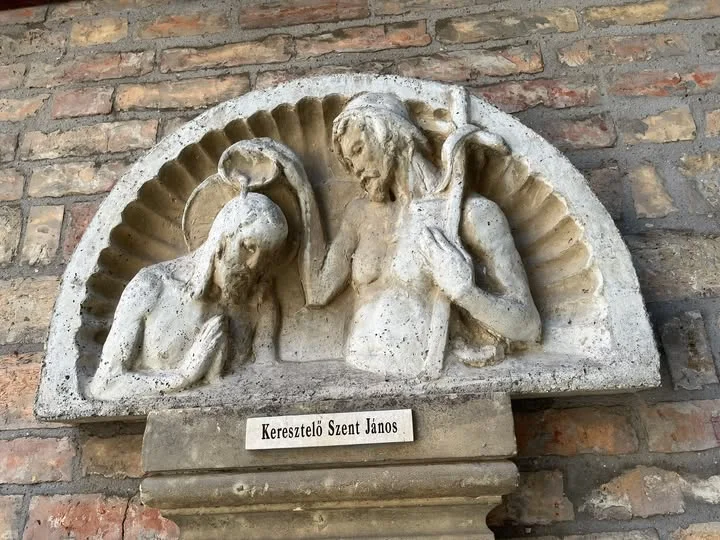
The relief set into the wall of Bory-vár depicts one of the best-known scenes in the Christian tradition: the Baptism of Jesus.
At the centre of the semicircular composition stand Jesus and Saint John the Baptist in the River Jordan. With his right hand John performs the gesture of baptism, while holding the long cross-staff characteristic of him. The scene’s simple, readily legible treatment accords well with the approach of Bory Jenő’s religious works, in which the essential content of the story matters more than detailed narration.
The event of the baptism is a fundamental moment in the Christian faith. According to tradition, Jesus’ divine mission was revealed at this point, and the scene is consequently closely linked to the feast of Epiphany. This feast recalls at once the homage of the Magi, Jesus’ public manifestation and his baptism in the Jordan. Baptism is a symbol of cleansing, rebirth and the beginning of new life, and has become one of the central messages of Christian thought.
The relief is restrained and harmonious in its modelling. The figures’ slight movements towards one another, the haloes above their heads and the shell-like treatment of the background create an atmosphere both solemn and intimate. Here too Bory Jenő sought to express a deeper spiritual content: the scene is not dramatic, but presented in a quiet form that invites contemplation.
Within the architectural ensemble of Bory-vár, the relief is not merely a decorative element with a religious subject, but one expression of the artist’s connection to Christian faith and universal human values. The work evokes the ideas of purification, faith and renewal, meanings that have defined the scene of the baptism for centuries.