


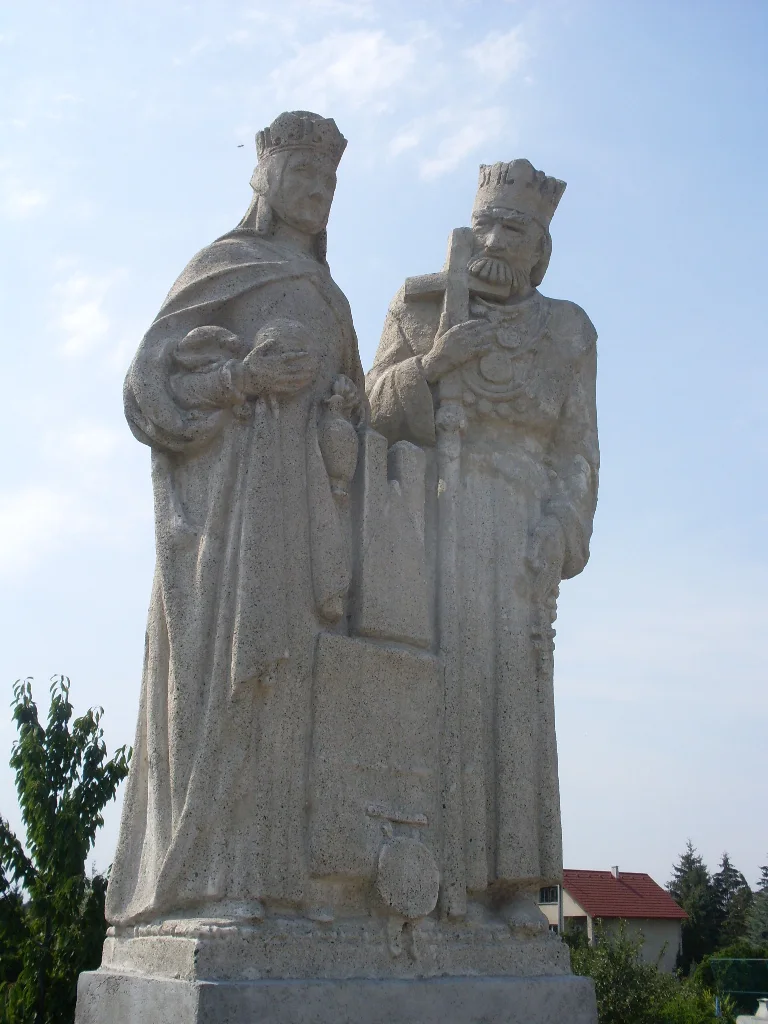
In the historical arcade, King András II and his daughter, Saint Erzsébet of the House of Árpád, appear together. In this way Bory Jenő emphasised not only their dynastic relationship, but also evoked two distinct yet defining historical legacies: royal authority and the Christian ideal of mercy.
At the centre of the composition is the figure of Saint Erzsébet. She holds roses in her hands and apron, referring to her best-known legend. Tradition holds that the bread she was carrying to the poor turned into roses when her charitable acts were called into question. This scene became one of the best-known symbols of Christian love and self-sacrifice, and Saint Erzsébet is therefore almost always depicted with roses in art.
Behind her stands her father, King András II, who ruled Hungary from 1205 to 1235. His name is associated with significant foreign-policy successes and the growth of the country’s international standing, but his most enduring measure was the Golden Bull issued in 1222, which became one of the foundational documents of Hungarian constitutionalism. Many of its provisions determined the Hungarian legal order for centuries.
Bory Jenő’s statue thus evokes at once one of the most significant rulers of the House of Árpád and the memory of the king’s daughter who became renowned throughout Europe for her sanctity. This union of royal authority and Christian compassion conveys well the spiritual and historical legacy of the medieval Kingdom of Hungary.