


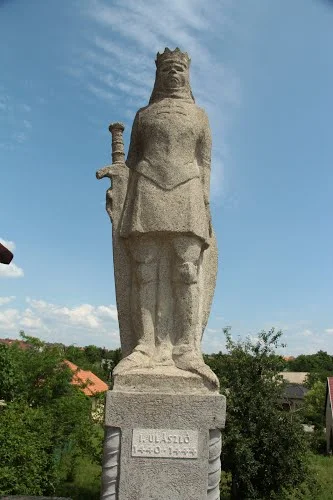
In the historical arcade, King Wladislaus I of Hungary evokes one of the most turbulent periods of the medieval Kingdom of Hungary. The ruler, who came from the Polish Jagiellonian dynasty, ascended the Hungarian throne in 1440, when the country became the arena of internal political struggles between the Habsburg and Jagiellonian parties.
The most important task of his reign was to halt the expansion of the Ottoman Empire. Hunyadi János played a decisive role in his government, and together they led several successful campaigns against the Turks. After the successes of the Long Campaign, however, the Christian armies embarked upon another expedition, which ended in tragedy.
On 10 November, at the Battle of Varna, the Hungarian–Polish army was defeated by the forces of Sultan Murad II. The king himself fell in the fighting. His death brought political uncertainty for a long time, while his figure became intertwined with the memory of the struggle against the Turks.
Bory Jenő’s statue presents Wladislaus I as a warrior ruler. A sword and shield are visible beside the crowned figure, clearly referring to his military role. The stern bearing and simple, compact modelling evoke the ideal of the medieval knight-king. In the historical arcade, Wladislaus I belongs among those rulers who risked their lives in defence of their country, and whose fate is closely connected to the anti-Ottoman struggles of Hungarian history.