


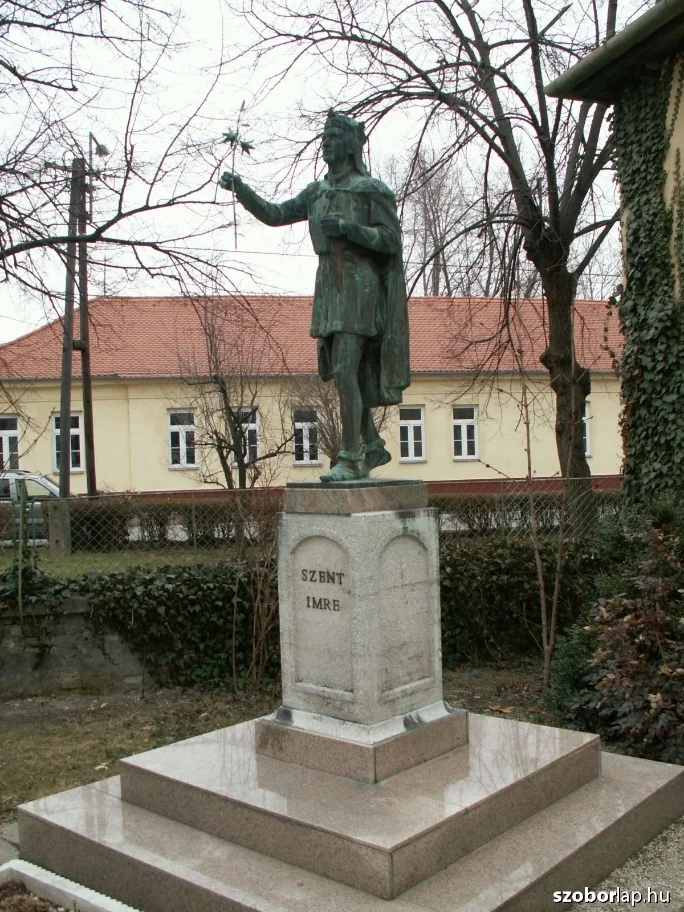
Bory Jenő’s statue of Saint Imre may be seen in Kalocsa, in the garden between Saint Imre Church and the parish house. The bronze figure appears in a quiet, contemplative pose, holding a single flower, the traditional symbol of purity and virginity. With its restrained, human-scale treatment, the work is well suited to the historical and religious memory of Saint Imre.
The history of the statue is particularly interesting. It was originally unveiled in Kalocsa on 5 November 1934, in front of the Teachers’ House, where it stood upon the corner post of a fence. It was later moved to a more fitting setting beside Saint Imre Church. The Saint Stephen commemorative year of 1938 may also have played a part in this, when increased attention was directed throughout the country towards the family of the king who founded the Hungarian state, and especially towards his son, Prince Imre.
The statue evokes the young heir to the throne, whom his parents brought up according to the ideal of a Christian ruler. Bishop Saint Gellért also took part in his education, and King Stephen wrote for him the work entitled Admonitions. It was hoped that the prince would continue his father’s work of organising the state, but he died in a hunting accident in 1031. Despite his short life, he became an exemplar of Christian youth and a pure life, and was canonised in 1083.
Alongside the bronze statue in Kalocsa, a plaster version of the work has also survived. This version appeared in 1930 at the exhibition of saints of the House of Árpád held at the National Salon, and may now be seen beneath the arcades of the Hundred-Column Courtyard at Bory-vár in Székesfehérvár. Together, the plaster model and the bronze statue illustrate Bory Jenő’s interest in Hungarian saints and historical personages, as well as his practice of preserving his important works in several versions.