


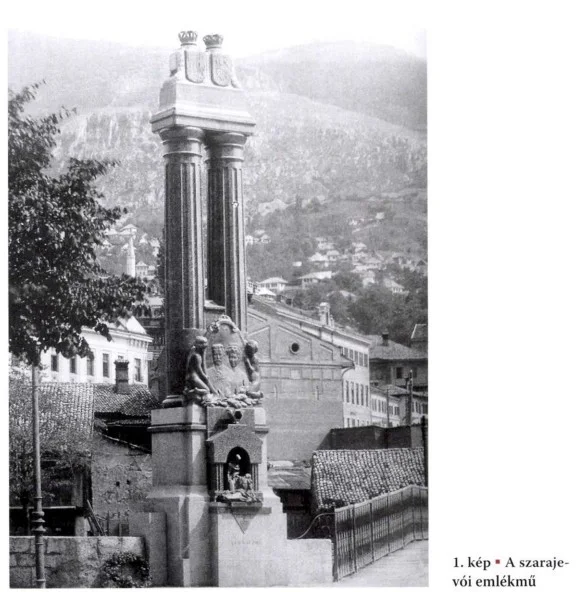
One of the most distinctive and internationally significant works in Bory Jenő’s oeuvre is the Franz Ferdinand Memorial in Sarajevo, erected at one of the world’s best-known historical sites, near the place of the Sarajevo assassination. It was not only Bory’s first major First World War memorial, but also commemorated an event that directly contributed to the outbreak of the war.
During the First World War Bory Jenő served as an engineer officer in the 17th honvéd Landsturm Infantry Regiment of Székesfehérvár. His battalion was posted to Bosnia in 1915, bringing him to Sarajevo. Alongside his military service, his artistic talent was also recognised. On 6 March 1916 General Stephan Sarkotić, military governor of Bosnia-Herzegovina, commissioned him to design a fitting memorial to the heir presumptive Franz Ferdinand, murdered on 28 June 1914, and his wife, Sophie of Hohenberg. Unusually, Bory was both architect and sculptor of the memorial.
The memorial could not be placed directly at the assassination site, as the street junction beside the Latin Bridge proved too narrow. Bory therefore created an artificial projection on the bank of the Miljacka, at the bridgehead of the Latin Bridge, on which he constructed the monumental work. The choice of site and its engineering solution were in themselves notable achievements.
The memorial’s central elements were two Czech granite columns, each about eight metres high. Their tops were adorned with the coats of arms of Franz Ferdinand and Duchess Sophie, surmounted by open ducal coronets. Between the columns stood a double bronze portrait relief of the heir presumptive and his wife, flanked by putti. Images of the relief’s large-scale model were already published in the contemporary press in 1916.
The artistic focus of the memorial’s lower part was a Pietà of exceptionally high quality: the Virgin Mary holding the dead Christ in her lap. Behind it was a coloured mosaic decoration, with a wrought-iron perpetual lamp above. On the evidence of surviving photographs, this was the most artistically and emotionally powerful part of the whole memorial.
Bory did not stop at erecting the principal memorial. Since it stood 12–15 metres from the point at which Gavrilo Princip’s shots struck the archducal couple, he marked the actual site with a separate memorial sign. A 2 × 1 metre steel plate, three centimetres thick, was set into the carriageway, bearing a Latin inscription commemorating the victims. The plate was even shown to the public in Budapest at the Christmas exhibition of the Museum of Applied Arts.
The composition’s third element was a large granite memorial bench on the opposite bank of the river. Its Latin inscription, ‘Siste Viator’ (‘Stop, traveller!’), called on passers-by to remember the tragic event. This bench survived even after the memorial’s dismantling, albeit without its inscription.
The memorial was executed almost entirely in Hungary. The Pietà was made at the Hungária Hungarian Metal Foundry; the bronze reliefs and coats of arms were cast at the Diósgyőr ironworks, and the steel plate was likewise produced by Hungarian industry. The work was therefore not only Bory Jenő’s creation, but also a representative presentation of Hungarian art and industry in the southern province of the Monarchy.
The memorial was unveiled on 29 June 1917, in connection with the events marking the third anniversary of the assassination. Archduke Friedrich represented the ruling house. The work was received so favourably that Bory Jenő was awarded the Knight’s Cross of the Order of Franz Joseph with war decoration in July 1917.
The memorial’s fate was tragically brief. After the collapse of the Monarchy, it was dismantled in February 1919. The steel plate set into the road was removed, the columns were taken apart, and the work disappeared from the cityscape for decades. It was long thought to have been completely destroyed, but research has shown that many elements survived. The bronze relief of Franz Ferdinand and Sophie, and the ducal coronets, are now in the collection of the National Museum of Bosnia and Herzegovina. The Pietà is kept by the Sarajevo Institute for the Protection of Cultural, Historical and Natural Heritage. The columns are believed to have been taken to Trebinje.
From the 2010s onwards, Bosnian and Hungarian specialists repeatedly raised the possibility of reconstructing the memorial. In 2026 the Sarajevo city administration officially placed the possibility of rebuilding it on its agenda. The plan is to reconstruct Bory’s work using surviving original elements and contemporary photographs.
The Franz Ferdinand Memorial in Sarajevo occupies a special place in Bory Jenő’s work. It was his first memorial of international importance, bringing together the architect, sculptor and designer of monumental memorials. The work anticipated his later major creations – the 17th honvéd memorial, Wounded Hero and the Bishops’ Fountain – and marked the beginning of the artistic career that made Bory Jenő one of the most significant Hungarian memorial sculptors of the twentieth century.
Alongside the Sarajevo memorial, Bory Jenő also prepared plans for a large Franz Ferdinand memorial church and a Sophie youth home (Sophianeum). Construction of the neo-Romanesque church, intended to accommodate several thousand worshippers, had begun in 1917: foundation works were under way, and Bory was even working on the interior sculptural decoration, preparing designs for praying figures of the archducal couple. The collapse of the Monarchy and the end of the war, however, prevented completion of the project, so the memorial church and its associated institution remained one of Bory Jenő’s most important but unrealised architectural enterprises.
Uj Idők, 1916 (22nd volume, issues 27–53)