


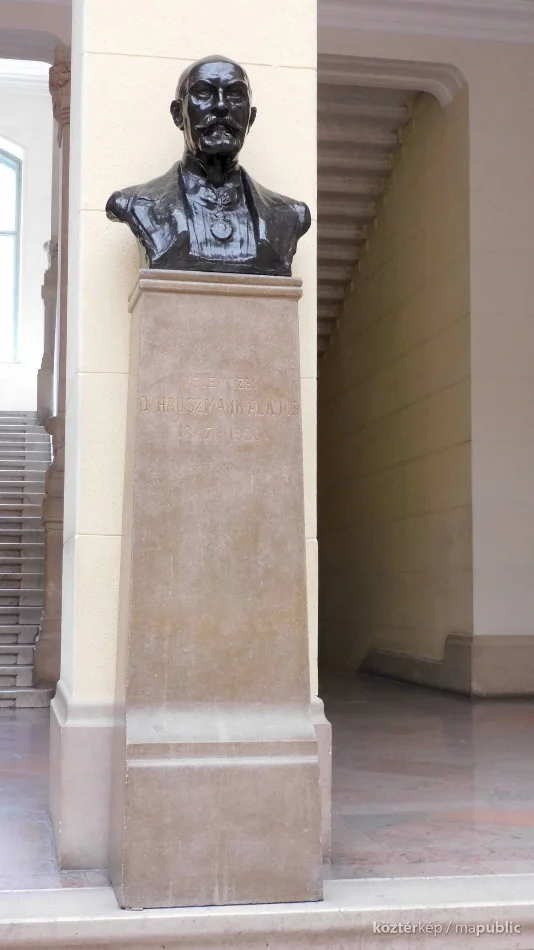
Bory Jenő’s bust of Hauszmann Alajos commemorates one of the defining architects of Hungarian Historicism. The portrait not only preserves the features of the renowned designer, but is also a tribute to a creator who played a decisive role in the development of the Műegyetem and Hungarian architecture.
Hauszmann Alajos (1847–1926) was an architect, university professor and academician. He studied at the Műegyetem, as well as studying painting, and he even gained practical experience as a mason when young. He retained a close connection to the Műegyetem throughout his life: from 1868 he worked at the institution as an assistant lecturer and later as a full professor. Numerous significant buildings are associated with his name, including the extension of the Royal Palace of Buda, the Palace of Justice, the New York Palace and the development of the historic complex of the Műegyetem. As an architect, he placed great emphasis on giving the allied arts—sculpture, painting and the applied arts—a worthy role within buildings.
Bory Jenő made the portrait in 1927 for the series of scientist and professor portraits in the entrance hall of the Budapesti Műegyetem. The bust depicts the elderly Hauszmann with resolute features, a reserved bearing and an authoritative appearance. Here the artist was chiefly concerned with capturing the architect’s intellectual character: the portrait evokes professor, scholar and designer of public buildings at once.
The work is made from the material known as pyrobasalt, often also referred to as “Bory bronze”. This special material used by Bory Jenő could be produced in several colour variations, and he used it for many of his portraits and smaller sculptures.
The Hauszmann portrait forms part of the gallery of portraits of scientists installed in the entrance hall of the Műegyetem, where sculptures of several figures who played a defining role in the history of Hungarian technical higher education can be seen. Hauszmann’s figure must have been especially close to Bory Jenő, since both were connected at once to architecture, education and the visual arts.