


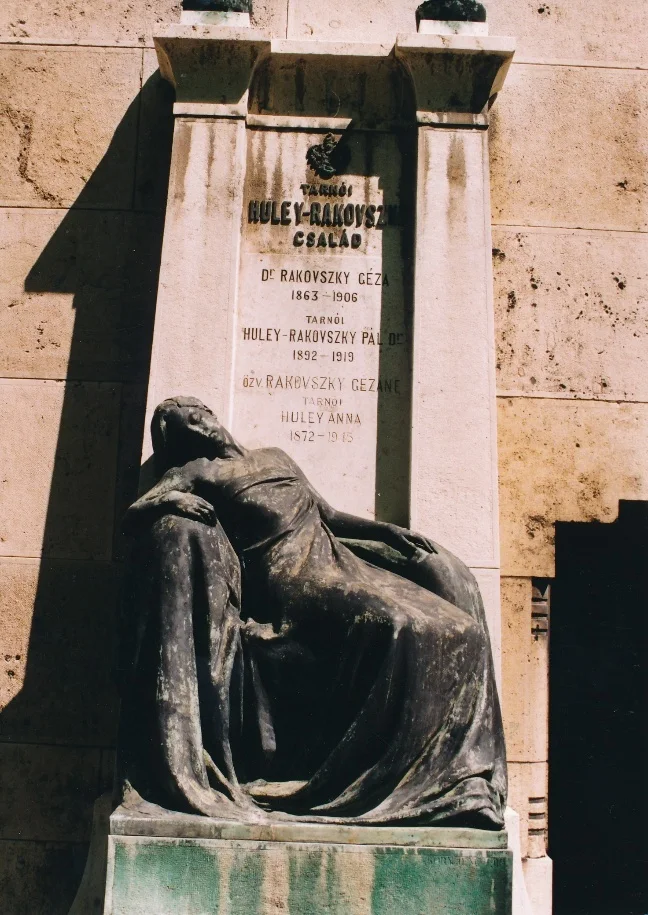
The tomb monument of the Tarnói Huley–Rakovszky family is one of the outstanding works of Bory Jenő’s early funerary sculpture, expressing grief and the pain of loss through the figure of a fainting woman.
Bory Jenő created the tomb monument of the Tarnói Huley–Rakovszky family in 1910. The monument stands in the right-hand arcade of the Kerepesi Road Cemetery in Budapest and is one of the significant works of the artist’s early funerary sculpture. It is signed ‘Bory Jenő 1910’.
The central element of the tomb monument is a 125-centimetre-high bronze female figure shown fainting, her body sinking downwards. The figure is not a portrait of a specific person, but an allegorical form embodying the family’s grief and the pain of loss. Behind the sculpture rises a 380-centimetre-high limestone architectural backdrop, providing a monumental frame for the delicately modelled bronze figure. This harmonious union of sculptural and architectural elements is a characteristic feature of Bory Jenő’s tomb monuments.
The tomb monument preserves the memory of the Tarnói Huley–Rakovszky family. Dr Géza Rakovszky (1863–1906), a member of the family, was a landowner at Mohora who belonged to the Kelemenfalva-Eger branch of the Rakovszky family. He is not to be confused with the similarly named Member of Parliament Géza Rakovszky (1845–1911), who came from another branch of the family. Pál Tarnói Huley–Rakovszky, the son of Dr Géza Rakovszky and Anna Tarnói Huley, also died at Mohora. The monument thus preserves the memory of two old noble families.
Of particular interest, a 132-centimetre-high plaster version of the bronze sculpture survives and can now be seen in the collection of Bory Castle in Székesfehérvár. The work attracted attention even at the time of its creation: the sculpture was also shown at the 1912 Spring Exhibition of the Műcsarnok.