


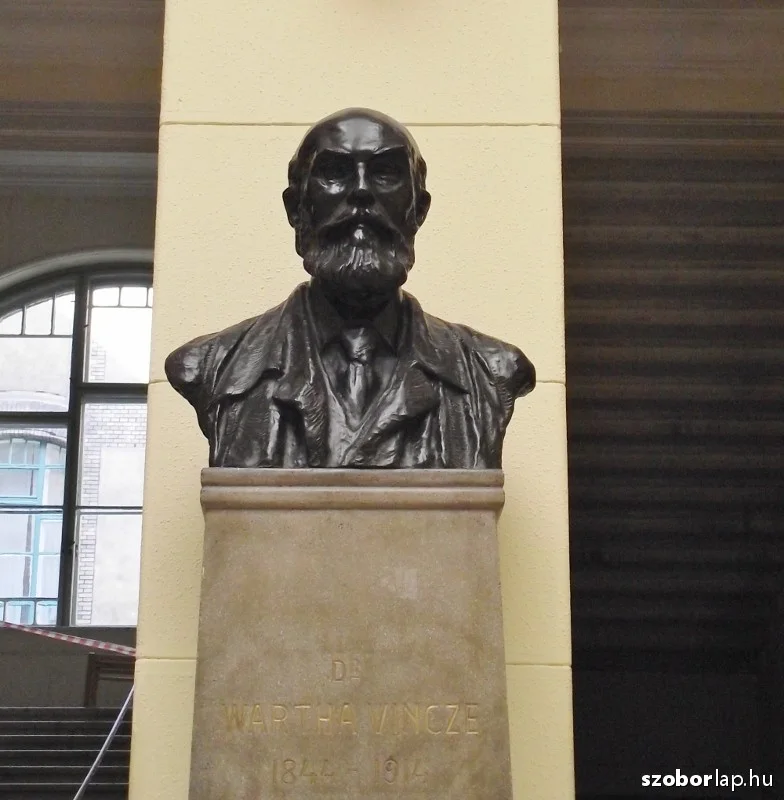
Bory Jenő’s bust of Wartha Vince commemorates one of the defining figures of Hungarian technical and natural-scientific life. The portrait preserves the intellectual authority of the scientist, university professor and academician, whose research and teaching left an enduring mark on the development of chemical engineering education in Hungary.
Wartha Vince (1844–1914) was a chemist, chemical engineer, professor at the Technical University, rector and member of the Magyar Tudományos Akadémia. He studied in Zürich and Heidelberg, then taught at the Budapesti Műegyetem from 1867. He organised and developed chemical engineering education and served twice as rector of the university. His scientific interests were exceptionally wide-ranging. He worked on water analysis, the coal and gas industries, wine chemistry, and played a significant role in preparing the development of Budapest’s waterworks. His best-known achievement is connected with the ceramics industry: his research led to the distinctive eosin glaze that established the international renown of the Zsolnay factory in Pécs. He later also contributed to the reorganisation of the porcelain factory at Herend.
Bory Jenő made Wartha Vince’s portrait in 1914 for the series of portraits of scientists in the entrance hall of the Budapesti Műegyetem. The bust depicts the scientist in old age, with a calm, composed expression. The artist was interested chiefly not in outward detail, but in capturing the professor’s intellectual authority and scholarly character. The portrait remains part of the university’s sculpture gallery today.
A copy of the sculpture was transferred to Pannon Egyetem in Veszprém in 1955. Wartha Vince was not chosen as a role model by chance: the university traces the intellectual antecedents of its chemistry education back to the Budapesti Műegyetem, where Wartha played a defining role as professor and founder of a department. His bust thus became a symbol of the traditions and scientific legacy of Hungarian chemical-engineering education.