


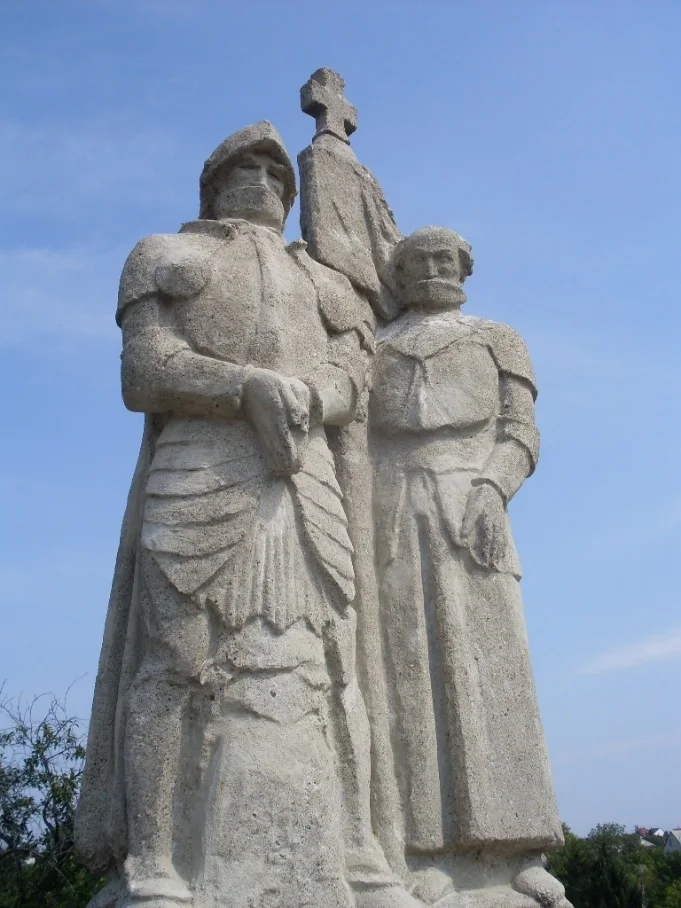
One sculptural group in the historical arcade brings together Hunyadi János and Kapisztrán János. With this composition, Bory Jenő recalled the victory at Nándorfehérvár in 1456, one of the defining military events in Hungarian and European history.
The armoured figure is Hunyadi János, the military commander of the fifteenth-century Kingdom of Hungary, who organised the defence against the Turks for decades. Through his military experience and skill in organising armies, he rose among the leading statesmen of the age. In the summer of 1456, he commanded the forces gathered to defend Nándorfehérvár when Sultan Mehmed II advanced with overwhelming numbers to seize the fortress.
Beside him stands Kapisztrán János, the Franciscan friar who arrived from Italy. Through his sermons, he mobilised crowds for the crusade against the Turks, and played a significant part in ensuring that the fortress’s defenders and volunteers held firm during the siege. The cross rising at the centre of the sculptural group refers to this spiritual and religious unity.
Bory presented the two figures beside one another: Hunyadi represents armed strength, Kapisztrán the strength of faith. The composition does not depict a battle scene, but rather the military and ecclesiastical leaders united for a common cause. The vertical axis of the cross also symbolically links the two men.
The victory at Nándorfehérvár on 22 July 1456 halted the Ottoman Empire’s further advance towards Central Europe. The tradition of the noon bell also preserves the memory of the triumph. Victory was soon followed by tragedy, however: within a few weeks, an epidemic that broke out in the camp claimed both Hunyadi János and Kapisztrán János.
The sculptural group in the historical arcade therefore commemorates both the victory at Nándorfehérvár and the two men whose names became inseparably linked in Hungarian history with the defence of the country and the preservation of Christian Europe.