


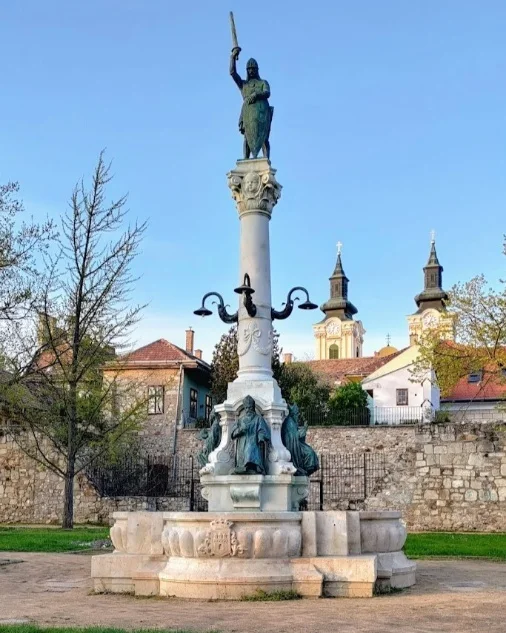
The statue of Saint Adalbert was originally made in 1928 as part of Bory Jenő’s work entitled Bishops’ Fountain. The monumental ornamental fountain was unveiled in Székesfehérvár on 24 June 1928, on the site now occupied by the Országalma. During successive urban redevelopment schemes the fountain was moved several times: in 1937 it was placed in the square before the railway station, and after the Second World War the bishop statues were removed from it. In 1972, to mark the millennium of the city’s foundation, it was restored to its original form at its present site in Piac tér, near the bus station.
One of the fountain’s four bishop statues is Saint Adalbert, placed on the south side of the composition. The seated figure appears in episcopal vestments. He raises his right hand in blessing and holds a book in his left, referring to his teaching and missionary activity. His calm bearing, compact composition and authoritative appearance accord well with Bory Jenő’s historicising sculptural style.
In the iconographic programme of the Bishops’ Fountain, Saint Adalbert represents the missionary Church. This role is closely connected to his historical importance. The Bohemian-born bishop (956–997) was among the most important missionaries in Central Europe, undertaking missionary work among Czechs, Poles, Prussians and Hungarians alike. During his work in Hungary he baptised Grand Prince Géza and his son Vajk, the future King Saint Stephen. According to tradition, King Stephen chose him as the patron saint of the Archdiocese of Esztergom.
Bory Jenő emphasised not the missionary who suffered martyrdom, but the figure of the teacher and spiritual guide. The deeply cut folds, long beard and mitre give the statue a solemn character, while the raised hand of blessing evokes the Church’s missionary calling and the ideal of spreading Christianity.
The sculptural figures of the Bishops’ Fountain serve both the city’s historical memory and Christian symbolism. Within this ensemble, Saint Adalbert is not merely a portrait of a historical personage but also a symbolic figure referring to the beginnings of Hungarian Christianity and the age of the foundation of the state.