


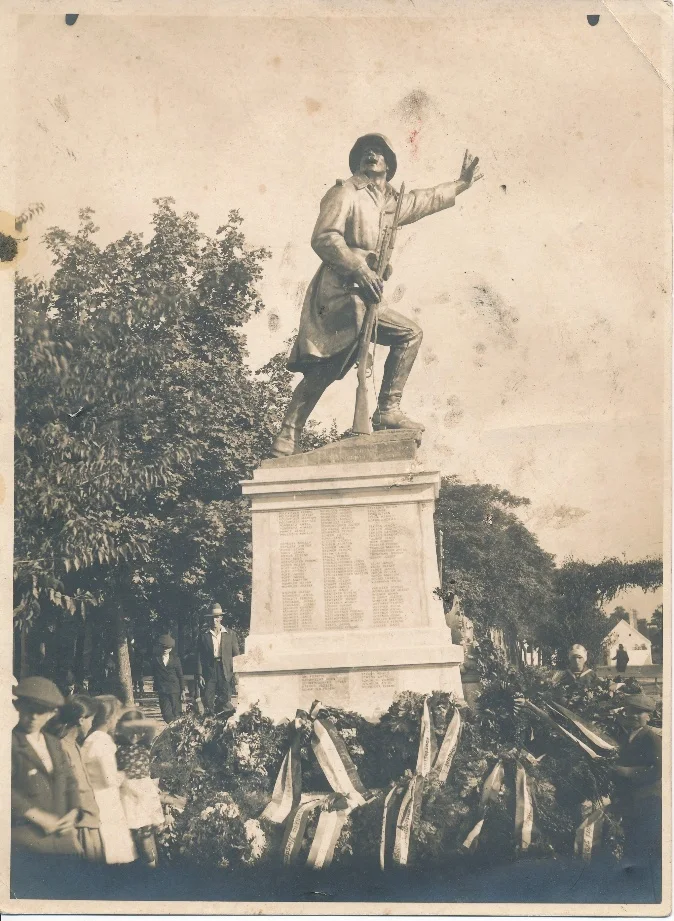
Among Bory Jenő’s First World War memorials, the heroes’ memorial at Mór occupies an outstanding place and is one of the settlement’s most important historical sites of remembrance. It preserves the memory of soldiers from Mór who fell in the war and clearly exemplifies the distinctive features of the sculptor’s memorial work between the two world wars.
The idea of erecting it arose in the 1920s, but financial difficulties long delayed its execution. The town’s sculpture committee eventually raised the necessary sum through donations, and the representative body chose Bory Jenő’s competition design from plans recommended by the National Fine Arts Council. According to the contemporary minutes, the body considered the ‘statue depicting a charging soldier’ the most suitable and commissioned the work for 16,500 pengő.
The memorial was unveiled in 1931, during commemorations associated with the anniversary of the Battle of Montello in 1918. The ceremony was a major social event, attended by many representatives of military, political and ecclesiastical life. The town’s community received the work as an enduring monument to the sacrifice of local heroes.
The central figure is a honvéd beginning a charge, shown in a surging forward movement. Bory Jenő portrayed heroism not in a calm, contemplative pose but at the moment of action. The dynamic gesture, leaning body and decisive modelling express the ideal of military steadfastness and self-sacrifice. The statue belongs to a common type of heroic memorial of the period, yet its plastic force and movement distinguish it from comparable works.
Bory’s brother, Pál Bory, who assisted in making many of the artist’s significant public works, cast the bronze statue. Its creation is thus a fine example of the Bory family’s shared creative work. Its formal solutions are related to Bory’s other First World War memorials, especially the ‘69th Forward!’ Memorial in Székesfehérvár, which likewise depicts a soldier in the momentum of attack.
The original plaster model can still be seen beneath the arcades of the Hundred-Column Courtyard at Bory-vár in Székesfehérvár. Among the many original sculptural models preserved there, it allows visitors to study the precursor of the realised public work. Together, the plaster model and the bronze memorial illustrate Bory Jenő’s creative method and his endeavour to portray heroic steadfastness in a dynamic, monumental form.
The First World War Memorial at Mór remains a defining public work in the town. It pays tribute not only to fallen soldiers but also to the generation that undertook service and sacrifice for the homeland. It is also a characteristic and important work of Bory Jenő’s memorial sculpture, enriching the townscape of Mór for almost a century.