


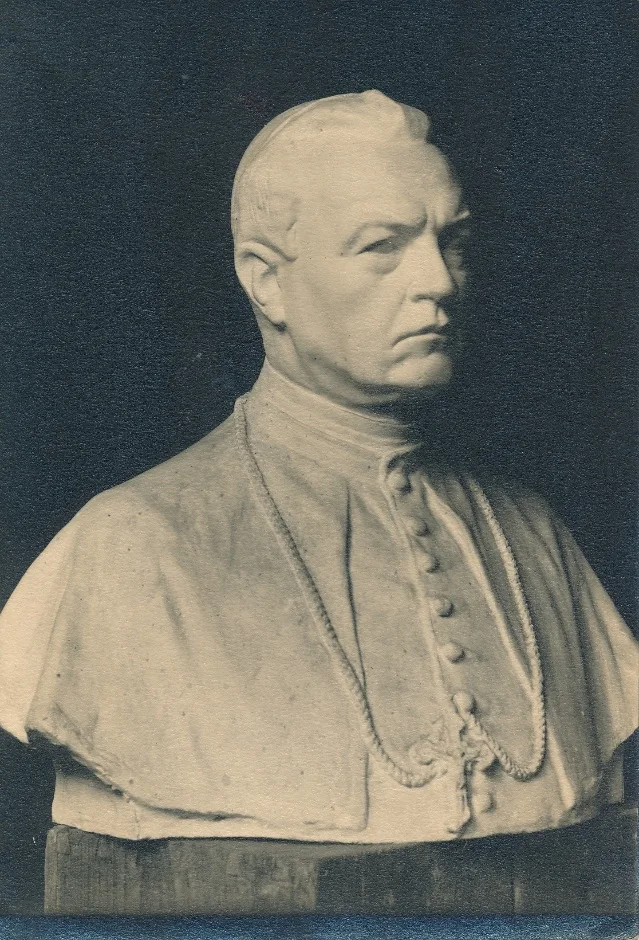
In 1926 Bory Jenő created the portrait sculpture of Prohászka Ottokár. The marble bust, 70 centimetres high, conveys the spiritual strength, resolute personality and ecclesiastical authority of the Bishop of Székesfehérvár.
Prohászka Ottokár (1858–1927), Bishop of Székesfehérvár, was one of the defining figures of the Hungarian Catholic Church and of Hungarian intellectual life in the early twentieth century. He gained national renown as an outstanding preacher, writer and social thinker. Bory Jenő also held the bishop in great personal esteem; his figure recurs in several of the artist’s works and in the memory of Székesfehérvár.
A distinctive feature of the portrait is that it was made during Prohászka’s lifetime. Bory did not wish to present an idealised church dignitary, but sought to capture the essence of the bishop’s character. The stern, forward-looking gaze, pressed lips and strongly modelled features suggest a personality who was at once pastor, thinker and public figure.
In a contemporary photograph of the surviving plaster model, the bishop appears in full ecclesiastical dress, with shoulder collar and episcopal chain. The marble sculpture now visible at Bory Castle preserves the likeness in a simpler form: the bust is worked more roughly, directing still greater attention to the character of the face and to the gaze. The work is an important piece in the portrait gallery at Bory Castle. It is not merely the likeness of an ecclesiastical personality, but a tribute to one of Székesfehérvár’s best-known bishops. The sculpture is at once a document of a historical personality and an example of Bory Jenő’s portrait sculpture, which strove to render the intellectual character of the subject alongside outward resemblance.
The 70-centimetre-high marble sculpture may still be seen in the collection at Bory Castle, where it has been placed among the scholars, artists and public figures commemorated by the artist.